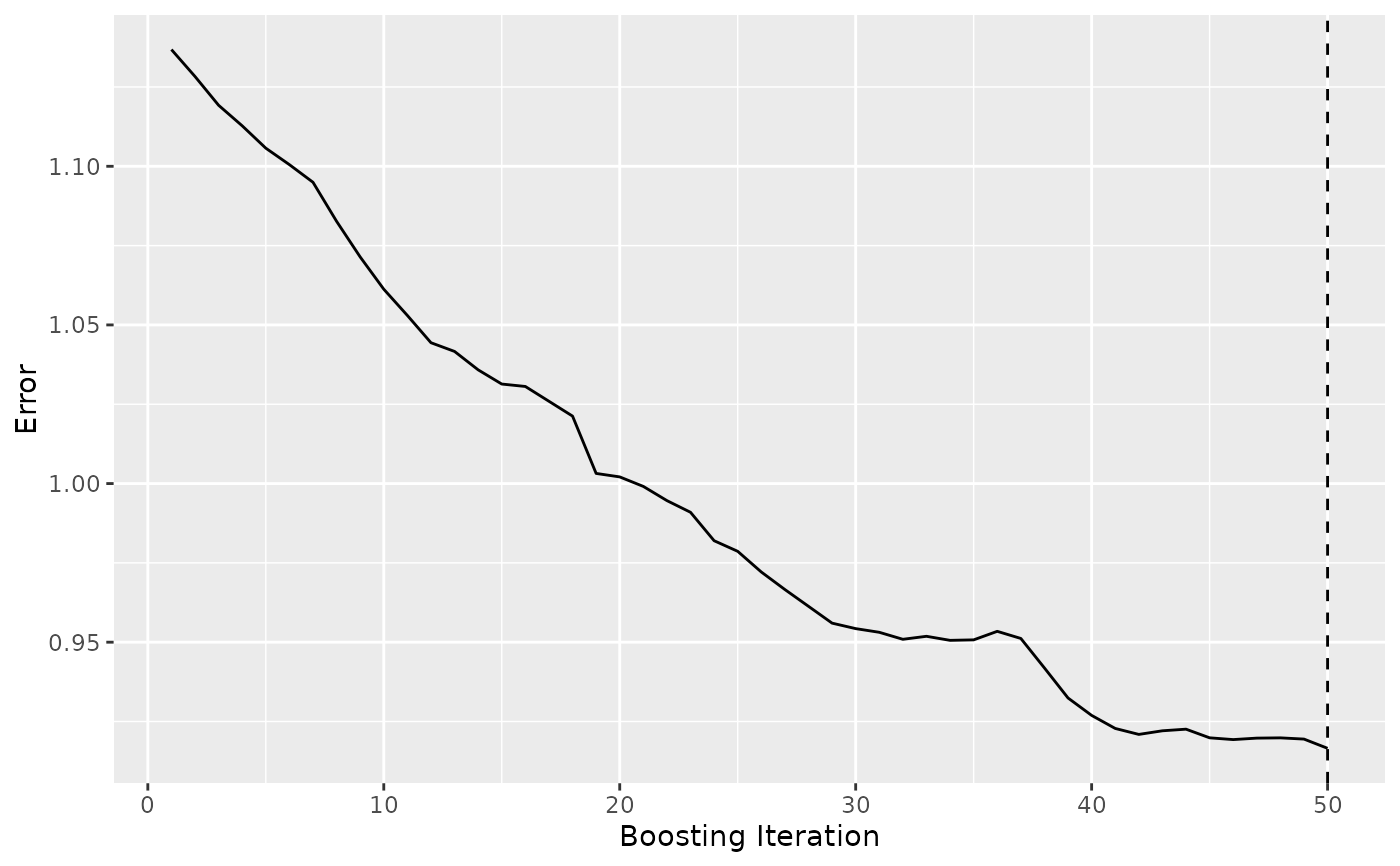
Extract the error path of a boosted multivariate tree fit as a function of the boosting iteration, together with the optimal iteration selected by cross-validation.
Arguments
- object
A fitted
boostmtreeobject, or a fittedBoostMLRobject.- use.rmse
Logical. When
TRUE(default) return the standardizedl2error; whenFALSEreturn the unstandardized squared error.- ...
Not used; present for S3 consistency.
Value
A gg_boost_error data.frame with columns:
- iteration
Integer boosting iteration, from 1.
- value
Numeric error at that iteration.
- response
Factor naming the response.
- optimal
Logical,
TRUEat the cross-validated optimal iteration.
Details
The fit must have been grown with cv.flag = TRUE. boostmtree
records err.rate and m.opt only when cross-validation ran; a default fit
carries neither, and there is no error path to extract. If this function
reports that the fit has no error path, refit with cv.flag = TRUE.
boostmtree stores the error on the standardized response scale in the
l2 column. use.rmse = FALSE returns (l2 * y.sd)^2, the squared error
on the original scale.
This figure also accepts a BoostMLR grow fit (predict
objects are not supported – see below). BoostMLR records Error_Rate
as an M-by-response matrix already on a single scale, so there is no
use.rmse argument for that backend; use.rmse = FALSE is refused,
while TRUE, the default, names the scale it already returns. BoostMLR
grow objects also select no optimal iteration anywhere in the object –
partial.BoostMLR() takes Mopt as a user-supplied argument instead –
so optimal is FALSE for every row; deriving an argmin here would
report a choice the backend never made.
A BoostMLR predict object is refused outright, even though it
shares the "BoostMLR" class and also carries an Error_Rate. Its
Error_Rate is test error rather than the training path documented above,
and it records a real Mopt that this extractor would otherwise silently
discard and overwrite with optimal = FALSE.
Examples
# \donttest{
sim <- boostmtree::simLong(n = 25, n.time = 4, model = 1)$data.list
fit <- boostmtree::boostmtree(
x = sim$features, tm = sim$time, id = sim$id, y = sim$y,
M = 50, cv.flag = TRUE, verbose = FALSE
)
gg_dta <- gg_boost_error(fit)
plot(gg_dta)
 # }