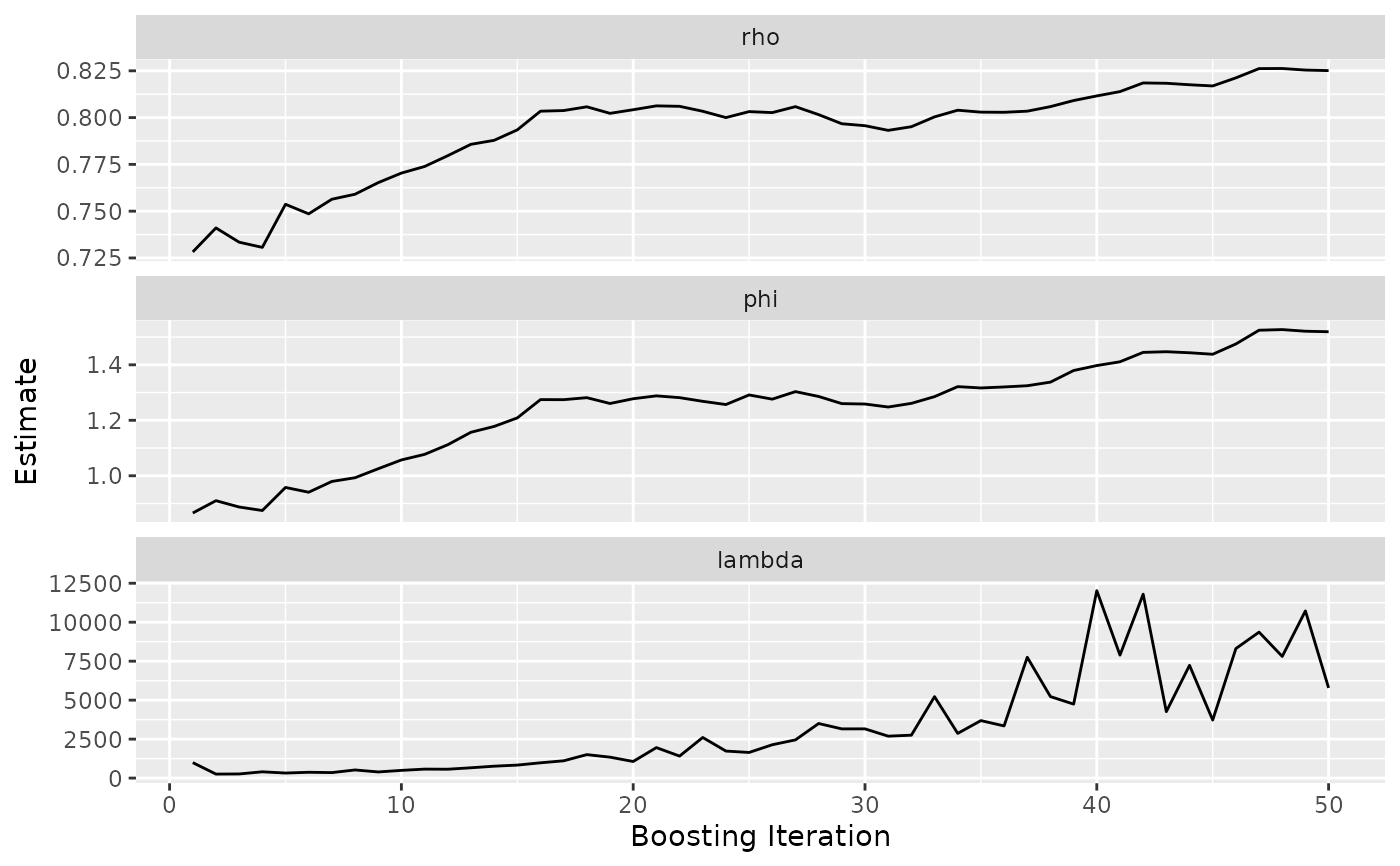
Extract the estimated correlation, variance, and penalized-spline smoothing parameters of a boosted multivariate tree fit as functions of the boosting iteration.
Usage
gg_boost_path(object, parameters = c("rho", "phi", "lambda"), ...)Arguments
- object
A fitted
boostmtreeobject, or a fittedBoostMLRobject.- parameters
Character vector naming the paths to extract. For a
boostmtreefit, any of"rho","phi", and"lambda", defaulting to all three. For aBoostMLRfit,"rho"and/or"phi"only, defaulting to both.- ...
Not used; present for S3 consistency.
Value
A gg_boost_path data.frame with columns:
- iteration
Integer boosting iteration, from 1.
- value
Numeric parameter value at that iteration.
- parameter
Factor naming the parameter.
- response
Factor naming the response.
Details
boostmtree re-estimates three quantities at every boosting iteration:
rho, the within-subject correlation; phi, the variance component; and
lambda, the P-spline smoothing parameter for the time-covariate
interaction. Their paths diagnose whether the variance structure settled or
is still drifting when boosting stops.
Unlike the error path, these are recorded on every fit and do not require
cv.flag = TRUE. A parameter absent from the fit is dropped silently; it is
an error only when none of the requested parameters is present.
This figure also accepts a BoostMLR fit, which records only Rho
and Phi as M-by-response matrices – the method's default parameters is
c("rho", "phi") rather than all three. BoostMLR has no comparable
lambda: its Lambda_List holds per-iteration basis coefficients rather
than a scalar smoothing parameter per response, a different quantity, so
requesting "lambda" from a BoostMLR fit is refused with that reason
instead of silently dropped.
Examples
# \donttest{
sim <- boostmtree::simLong(n = 25, n.time = 4, model = 1)$data.list
fit <- boostmtree::boostmtree(
x = sim$features, tm = sim$time, id = sim$id, y = sim$y,
M = 50, cv.flag = TRUE, verbose = FALSE
)
plot(gg_boost_path(fit))
 # }