Extract variable importance from a vimp.boostmtree
object, or from a BoostMLR predict object, for both the main effect of
each covariate and its interaction with time.
Usage
gg_boost_vimp(object, components = c("main", "interaction"), ...)Arguments
- object
A
vimp.boostmtreeobject, or aBoostMLRpredict object made withimportance = TRUE.- components
Character vector naming the components to extract, any of
"main"and"interaction". Defaults to both.- ...
Not used; present for S3 consistency.
Value
A gg_boost_vimp data.frame with columns:
- variable
Factor covariate name.
- importance
Numeric importance.
- component
Factor,
mainorinteraction.- response
Factor naming the response.
with attributes metric (the importance metric) and time.effect, plus
interaction.by.interval for BoostMLR.
Details
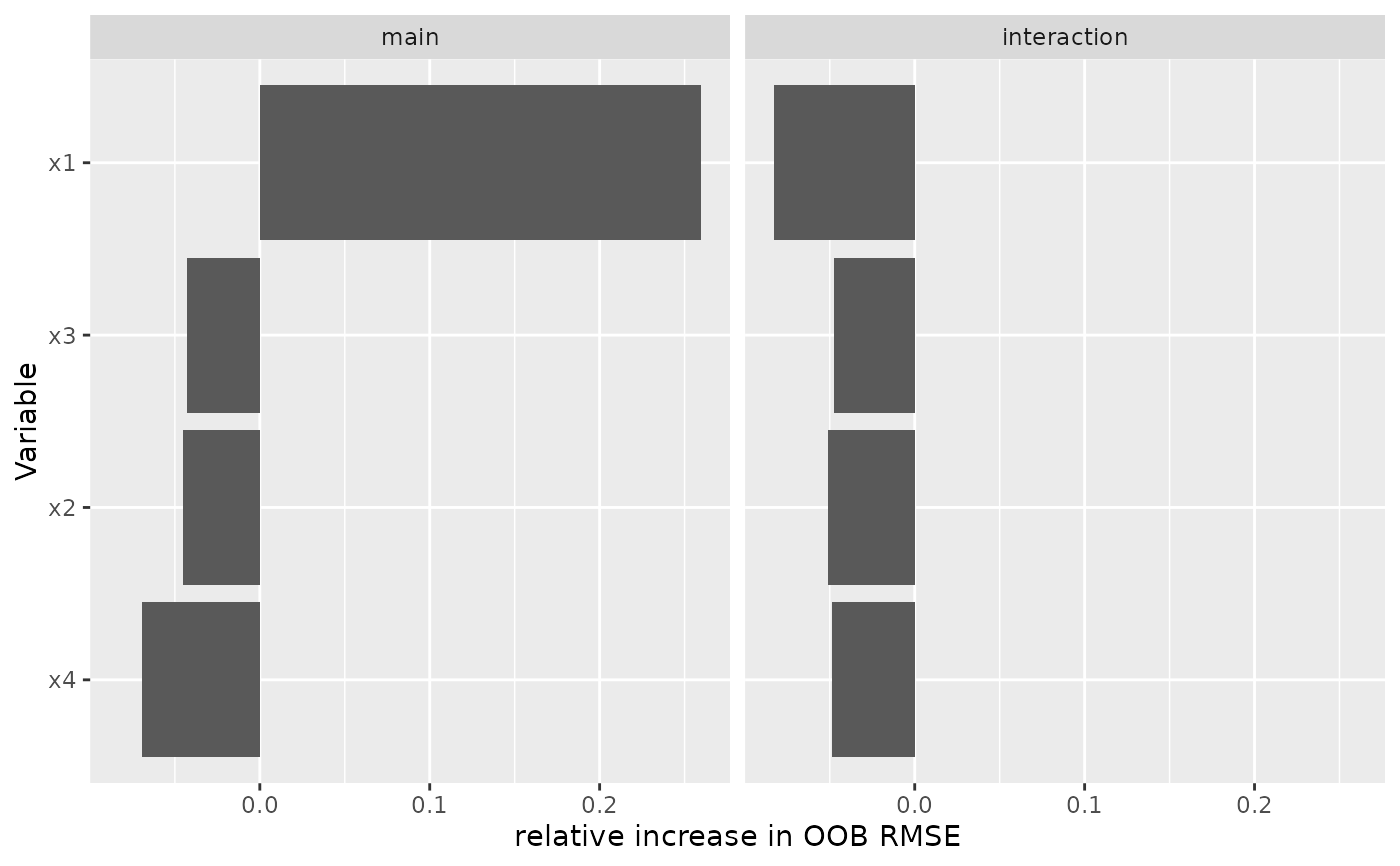
boostmtree reports importance in two parts. The main effect asks what is
lost by perturbing a covariate; the interaction asks what is lost by
perturbing its interaction with time. For a longitudinal model the second is
often the interesting one, since it is where a covariate whose effect
changes over follow-up shows up.
boostmtree labels the interaction rows x1:time, x2:time and so on. The
suffix is stripped here, so a variable carries one label across both
components and can be compared or dodged against itself.
The importance metric is a string on the source object rather than a fixed
quantity, so it travels as the metric attribute and the renderer uses it to
label the axis. The overall time effect has no variable to attach to and
travels as the time.effect attribute.
A joint importance object (vimp.boostmtree(fit, joint = TRUE)) reports a
single combined value, labelled joint.vimp. Note that CRAN boostmtree
2.0.0 cannot produce one at all; the patched build this package requires is
needed to compute it.
BoostMLR computes importance inside prediction: pass the object returned
by BoostMLR::predictBoostMLR(fit, x, tm, id, y, importance = TRUE), whose
$vimp holds one matrix per response. BoostMLR splits the covariate-time
interaction across its overlapping time intervals (columns Int_Eff.1,
Int_Eff.2, ...); these are summed here to one interaction value per
covariate so the result has the same shape as for boostmtree. The
per-interval matrices travel unsummed as the interaction.by.interval
attribute, one per response. The metric is "Standardized VIMP", and no
time.effect is recorded. A joint importance from
BoostMLR::vimp.BoostMLR(joint = TRUE) is a bare list and is not accepted.
Examples
# \donttest{
sim <- boostmtree::simLong(n = 25, n.time = 4, model = 1)$data.list
fit <- boostmtree::boostmtree(
x = sim$features, tm = sim$time, id = sim$id, y = sim$y,
M = 50, cv.flag = TRUE, verbose = FALSE
)
plot(gg_boost_vimp(boostmtree::vimp.boostmtree(fit)))
 # }