ggRandomForests reads three upstream fit mappings: randomForestSRC::rfsrc() -> rfsrc, randomForestRHF::rhf() -> rhf, and varPro::varpro() -> varpro. It also reads randomForest fits. A fitted forest carries a lot of information, but getting at it usually means digging through list structures that were never meant to be plotted directly. ggRandomForests does that digging for you, pulling tidy data objects out of the fit so they drop straight into the ggplot2 workflows you already know. The varPro engine (Lu and Ishwaran 2024; Ishwaran and Kogalur 2026) powers a parallel family of functions for release-rule importance and related diagnostics; that family is covered in the companion vignette referenced at the end. This vignette walks through the three objects you will reach for most often (gg_error, gg_variable, and gg_vimp), plus a small helper for cutting a predictor into evenly populated groups.
RHF support is only an overview here.
Error trajectories with gg_error()
Type rfNews() to see new features/changes/bug fixes.
set.seed(42)
rf_iris <- randomForest(Species ~ ., data = iris, ntree = 100, keep.forest = TRUE)
err_df <- ggRandomForests::gg_error(rf_iris, training = TRUE)
head(err_df)
<gg_error> from randomForest | family: classification | ntree: 100 | n: 150
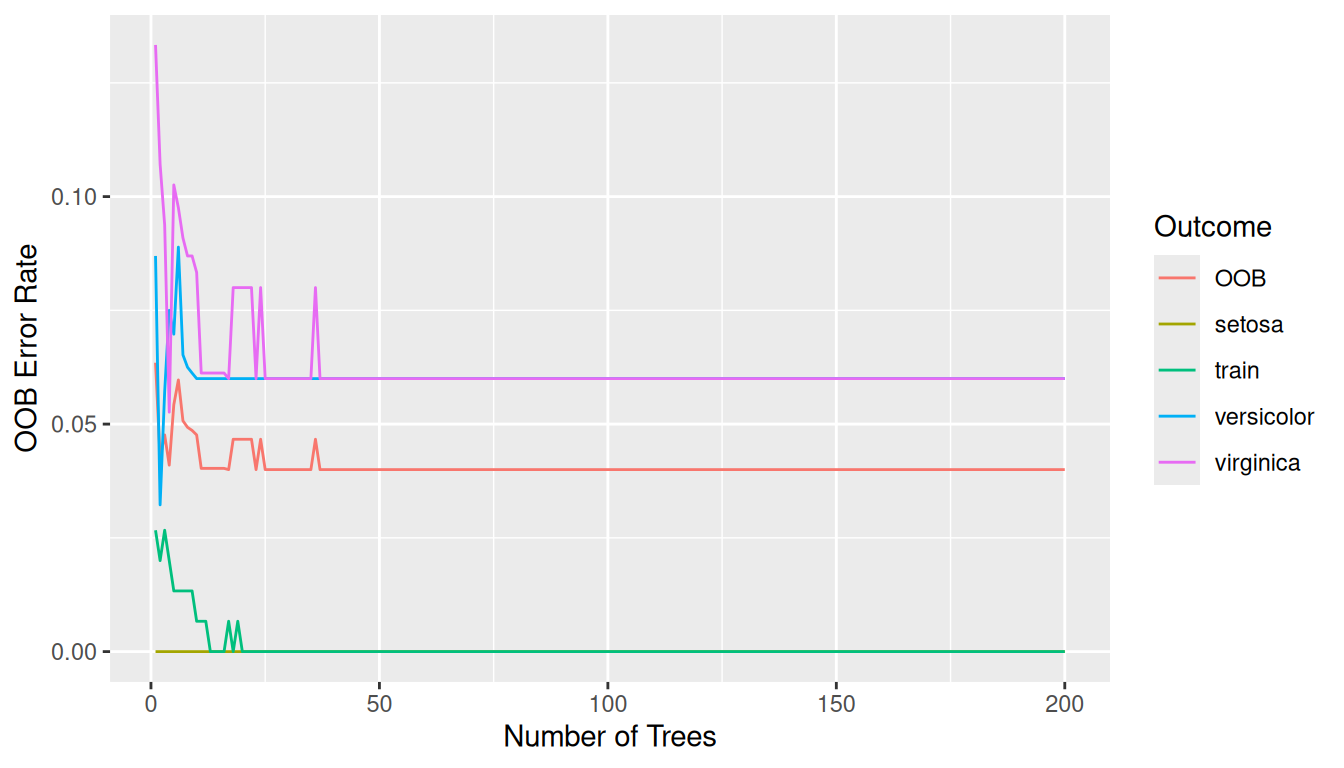
A forest’s error rate settles down as trees are added, and the gg_error() object lets you watch that happen. It holds the cumulative out-of-bag (OOB) error rate for each outcome column, indexed by the ntree counter. Ask for training = TRUE and the function reconstructs the original model frame and adds the in-bag error trajectory (train) as well, so you can see both curves at once:
Marginal dependence via gg_variable()
Classes 'gg_variable', 'regression' and 'data.frame':   506 obs. of  2 variables:
 $ lstat: num  4.98 9.14 4.03 2.94 5.33 ...
 $ yhat : num  28.8 22.7 34.5 36.9 33.7 ...
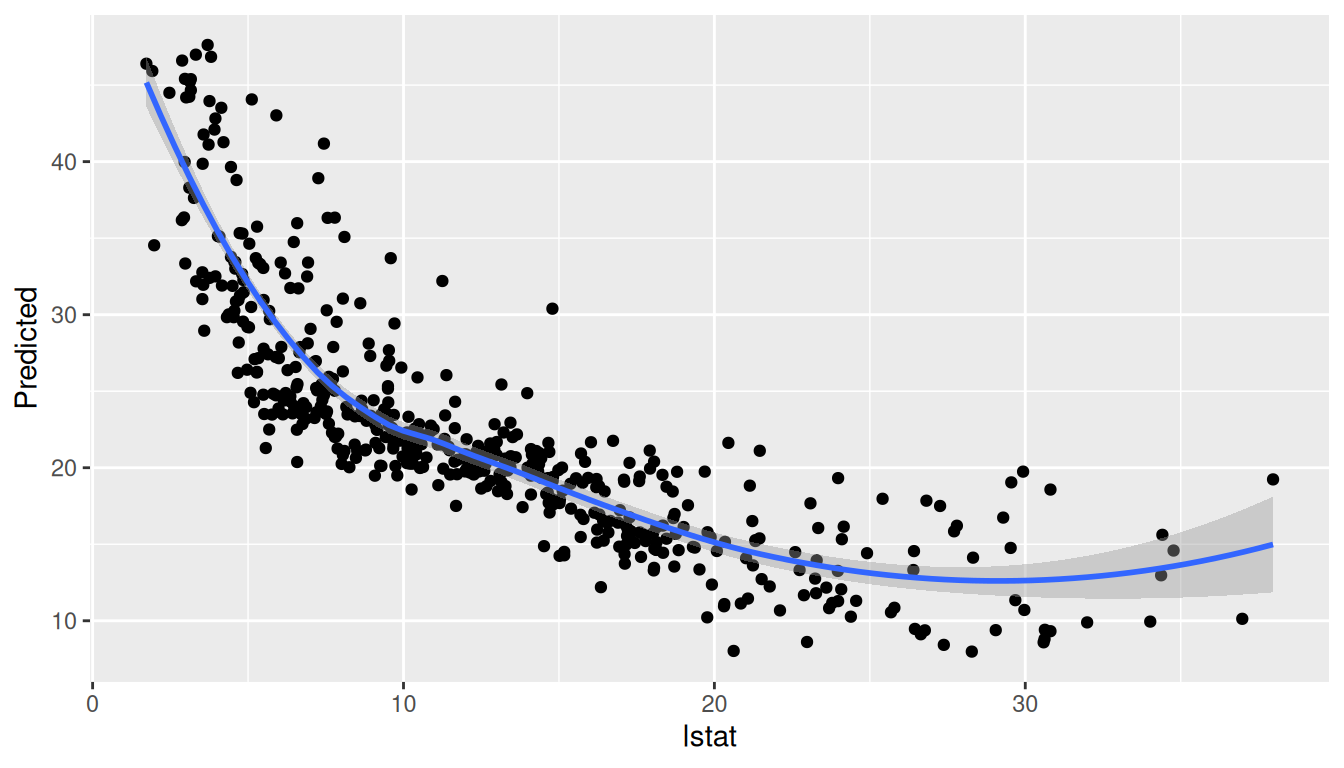
gg_variable() recovers the training data straight from the model call, so it still works when the forest was fit inside a helper function or against a subset() expression, cases where the data is not sitting in the global environment. The object you get back keeps the raw predictors alongside the prediction: a single yhat column for regression, or one yhat.<class> column per class for classification. To plot one predictor, name it with xvar:
plot(var_df, xvar = "lstat")
`geom_smooth()` using method = 'loess' and formula = 'y ~ x'
Survival forests can request multiple horizons using the time argument; non-OOB predictions are available by setting oob = FALSE.
Variable importance with gg_vimp()
vimp_df <- ggRandomForests::gg_vimp(rf_boston)
head(vimp_df)
<gg_vimp> from randomForest | family: regression | ntree: 100 | n: 506 | variables: 6
gg_vimp() measures permutation importance: each predictor is permuted in turn, and the drop in OOB accuracy gives its score. This contrasts with the gg_varpro family, which uses release-rule importance from the varPro engine. Variable importance is not always stored on the fitted object. If a randomForest fit is missing its importance scores, gg_vimp() will try to compute them for you. When even that is not possible (the forest was grown with importance = FALSE and the predictors are no longer reachable), the function warns and returns NA in place of the scores, so a plot still draws rather than failing outright.
Balanced conditioning cuts with quantile_pts()
rm_breaks <- ggRandomForests::quantile_pts(boston$rm, groups = 6, intervals = TRUE)
rm_groups <- cut(boston$rm, breaks = rm_breaks)
table(rm_groups)
rm_groups
(3.56,5.76] (5.76,5.99] (5.99,6.21] (6.21,6.44] (6.44,6.85] (6.85,8.78]
         85          84          84          85          84          84
When you build a coplot, you want each conditioning group to hold a roughly equal share of the data; equal-width bins leave the sparse tails nearly empty. quantile_pts() wraps stats::quantile() to give you break points that do exactly that, and they pass straight to cut() for the grouping or facet labels.
Next steps
- The full API reference lives at https://ehrlinger.github.io/ggRandomForests/.
-
?gg_error, ?gg_variable, ?gg_vimp, and ?quantile_pts cover the remaining arguments and have their own examples.
- The
gg_error, gg_variable, and gg_vimp objects shown here are tidy data frames underneath, so you can skip the plot() methods entirely and build the figure yourself with ggplot2.
- For the full varPro toolkit (release-rule importance, lasso-refined importance, per-observation local importance, anomaly scores, and the dependency graph) walked across regression, classification, and survival examples, see
vignette("varpro", package = "ggRandomForests").
Ishwaran, Hemant, and Udaya B. Kogalur. 2026.
Model-Independent Variable Selection via the Rule-Based Variable Priority.
https://cran.r-project.org/package=varPro.
Lu, M., and H. Ishwaran. 2024.
“Model-Independent Variable Selection via the Rule-Based Variable Priority.” arXiv Preprint.
https://arxiv.org/abs/2409.09003.