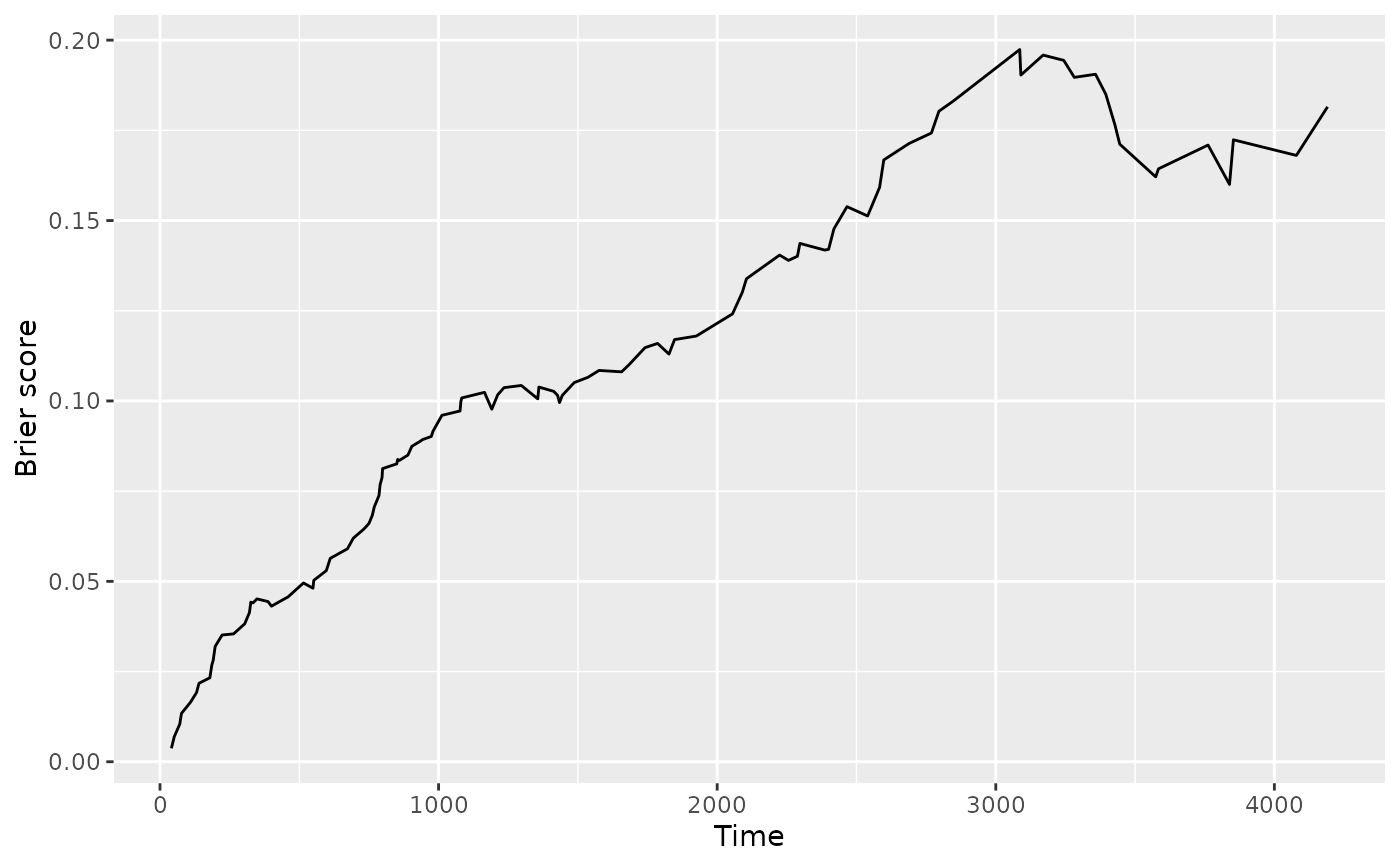
The Brier score asks a familiar question of any probabilistic forecast:
how far did the predicted probability sit from what actually happened?
For a survival forest the forecast is the predicted survival probability
at a given moment, and the "what happened" is whether the subject was
still alive at that moment. The score is computed at every event time,
so you get a curve rather than a single number, and lower is better
everywhere. A perfectly calibrated forest that predicts 0 for
every subject who died and 1 for every subject who survived would
score 0; a forest that predicts 0.5 for everyone scores
roughly 0.25 regardless of the true outcome. That is the
"uninformative" reference, not a ceiling; a forest can score worse than
it.
Arguments
- object
A fitted
rfsrcsurvival forest (object$family == "surv").- ...
Currently unused; accepted for S3 dispatch compatibility.
Value
A gg_brier data.frame with columns
- time
event time grid (
object$time.interest).- brier
overall Brier score at each time.
- bs.q25, bs.q50, bs.q75, bs.q100
Brier score within each mortality-risk quartile (lowest to highest risk).
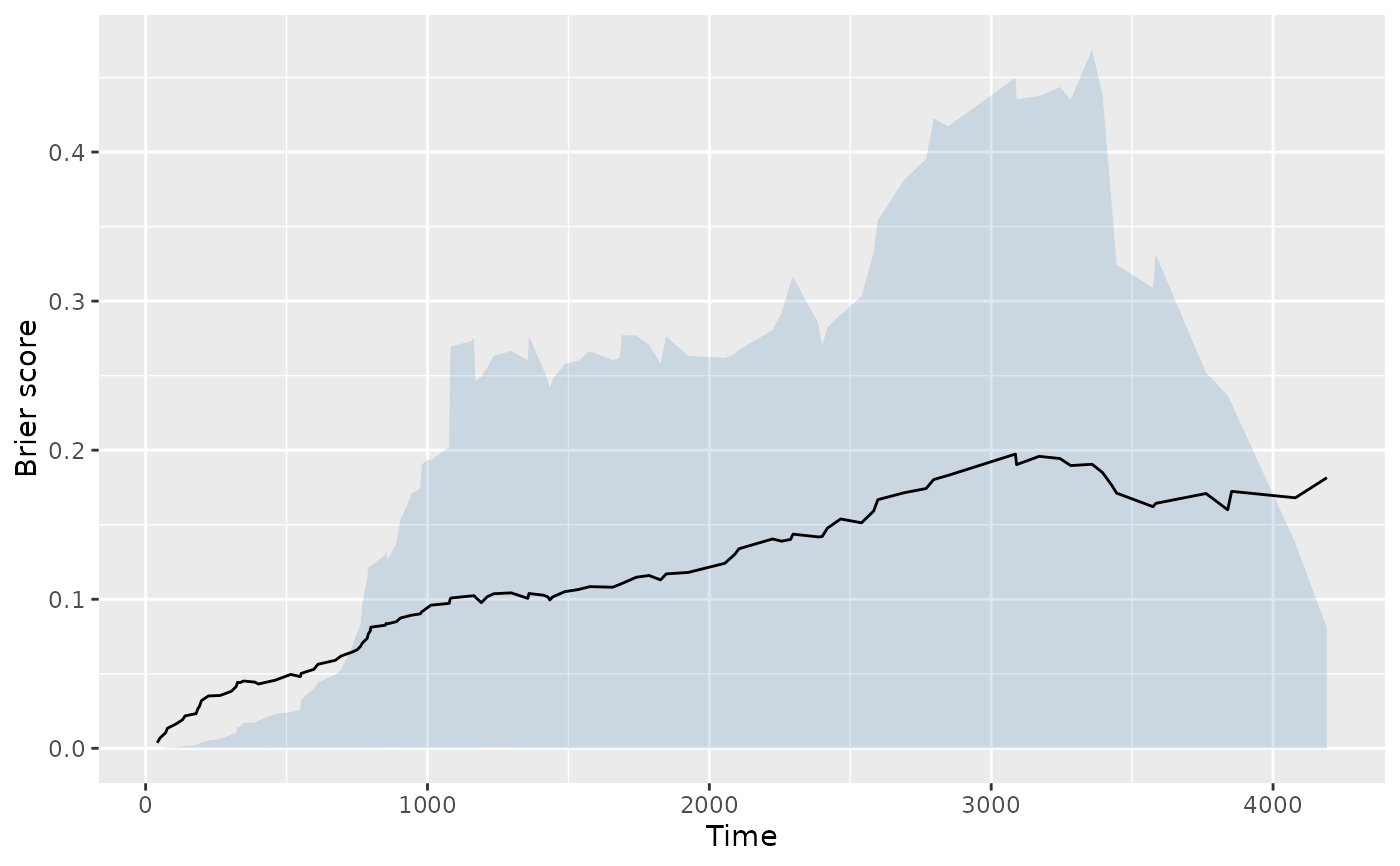
- bs.lower, bs.upper
15th and 85th percentile of per-subject Brier contributions at each time. Used by
plot.gg_brier(by_quartile = TRUE)to draw an envelope around the overall curve.- crps
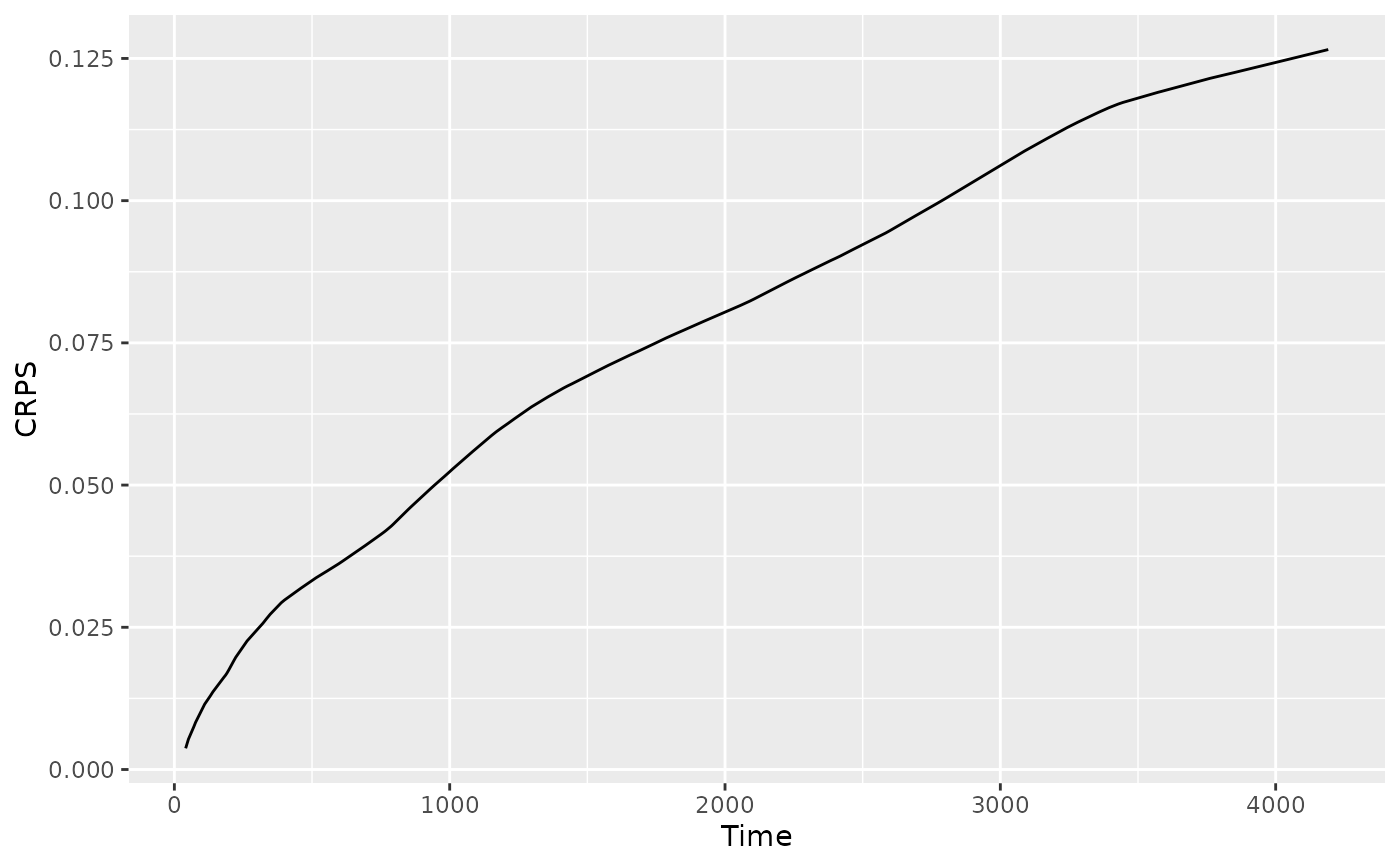
running CRPS (overall) at each time, normalized by elapsed time.
- crps.q25, crps.q50, crps.q75, crps.q100
running CRPS within each mortality-risk quartile.
- crps.lower, crps.upper
running CRPS of the 15th / 85th per-subject Brier percentile, normalized by elapsed time.
The integrated CRPS is attached as attr(., "crps_integrated").
It is get.brier.survival()$crps, the raw area under the Brier
curve, not normalized by time, so it is in the units of the time axis
and grows with follow-up. The time-normalized value,
get.brier.survival()$crps.std (the raw integral divided by
max(.$time)), is attached as attr(., "crps_std") and reads
on the Brier scale. The last value of the crps column instead
divides by the time elapsed since the first event time.
Details
This function extracts the time-resolved Brier score for a survival
forest grown with randomForestSRC, both overall and broken down
by mortality-risk quartile (lowest-risk to highest-risk subjects). It
also returns, in the crps column, the running continuous ranked
probability score (CRPS): the Brier score integrated over time and divided
by elapsed time, so each value summarizes calibration up to that point on
the time axis.
Because subjects are right-censored, a plain Brier score is biased:
censored subjects contribute no outcome information yet still inflate the
denominator. The score here uses inverse-probability-of-censoring
weighting (IPCW), which up-weights uncensored observations to compensate.
The censoring distribution is estimated either by Kaplan-Meier
(cens.model = "km", the default) or by a separate censoring
forest (cens.model = "rfsrc") when the censoring mechanism is
itself covariate-dependent.
Internally, this wraps get.brier.survival
and rebuilds the quartile decomposition and running CRPS from the returned
brier.matx and mort components, following the approach in
the internal plot.survival of randomForestSRC.
References
Graf E., Schmoor C., Sauerbrei W., Schumacher M. (1999). Assessment and comparison of prognostic classification schemes for survival data. Statistics in Medicine, 18(17-18):2529-2545.
Gerds T.A., Schumacher M. (2006). Consistent estimation of the expected Brier score in general survival models with right-censored event times. Biometrical Journal, 48(6):1029-1040.
Examples
# \donttest{
library(survival) # Surv() must be on the search path for rfsrc()
#>
#> Attaching package: ‘survival’
#> The following object is masked _by_ ‘.GlobalEnv’:
#>
#> pbc
data(pbc, package = "randomForestSRC")
rfsrc_pbc <- randomForestSRC::rfsrc(
Surv(days, status) ~ ., data = pbc, nsplit = 10, ntree = 100
)
gg_dta <- gg_brier(rfsrc_pbc)
plot(gg_dta)
 plot(gg_dta, type = "crps")
 plot(gg_dta, envelope = TRUE) # overall line + 15-85% envelope
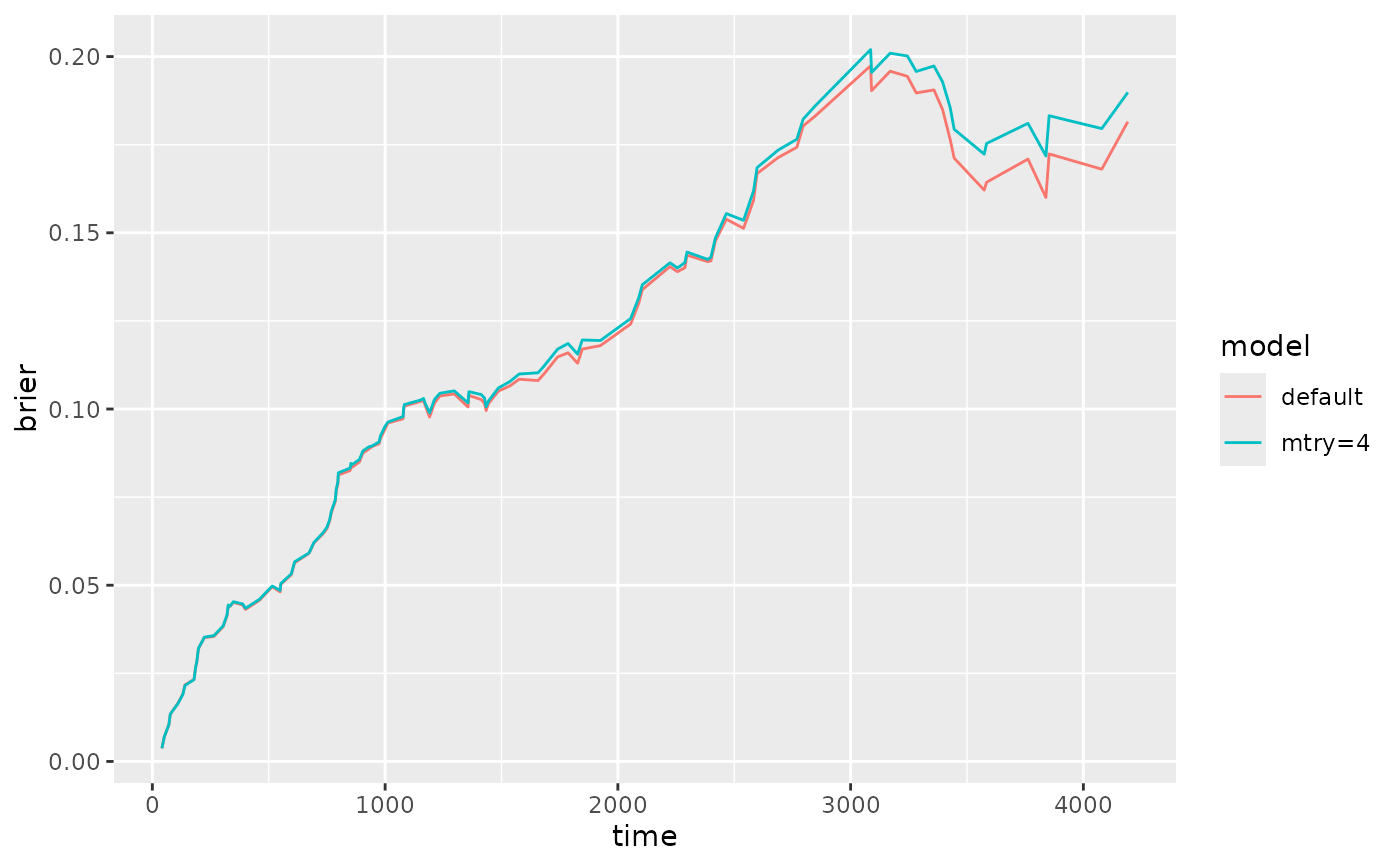
 # Multi-model comparison: stack gg_brier outputs and plot with ggplot2.
rf2 <- randomForestSRC::rfsrc(
Surv(days, status) ~ ., data = pbc, nsplit = 10, mtry = 4, ntree = 100
)
compare_dta <- dplyr::bind_rows(
dplyr::mutate(gg_brier(rfsrc_pbc), model = "default"),
dplyr::mutate(gg_brier(rf2), model = "mtry=4")
)
ggplot2::ggplot(compare_dta,
ggplot2::aes(x = time, y = brier, color = model)) +
ggplot2::geom_line()
# Multi-model comparison: stack gg_brier outputs and plot with ggplot2.
rf2 <- randomForestSRC::rfsrc(
Surv(days, status) ~ ., data = pbc, nsplit = 10, mtry = 4, ntree = 100
)
compare_dta <- dplyr::bind_rows(
dplyr::mutate(gg_brier(rfsrc_pbc), model = "default"),
dplyr::mutate(gg_brier(rf2), model = "mtry=4")
)
ggplot2::ggplot(compare_dta,
ggplot2::aes(x = time, y = brier, color = model)) +
ggplot2::geom_line()
 # }
# }