Every tree in a random forest makes its own prediction, and the forest's
"ensemble" prediction is the average across all trees. The out-of-bag
(OOB) variant averages only over the trees that did not include a given
observation in their bootstrap sample – a built-in cross-validation
estimate that requires no held-out test set. gg_rfsrc pulls those
ensemble predictions out of the fitted forest and arranges them for plotting
with plot.gg_rfsrc.
Arguments
- object
A fitted
rfsrcorrandomForestobject.- oob
Logical; if
TRUE(default) return out-of-bag predictions. Set toFALSEto use full in-bag (training) predictions. Forced toFALSEautomatically forpredict.rfsrcobjects, which carry no OOB estimates.- by
Optional stratifying variable. Either a character column name present in the training data, or a vector/factor of the same length as the training set. When supplied, a
groupcolumn is added to the returned data and bootstrap CI bands (survival) are computed per group. Omit or leave missing to return an unstratified result.- ...
Additional arguments controlling output for specific forest families:
- surv_type
Character; one of
"surv"(default),"chf", or"mortality"for survival forests.- conf.int
Numeric coverage probability (e.g.
0.95) to request bootstrap pointwise confidence bands for survival forests. Triggers wide-format output withlower,upper,median, andmeancolumns.- bs.sample
Integer; number of bootstrap resamples when
conf.intis set. Defaults to the number of observations.
Value
A gg_rfsrc object (a classed data.frame) whose
structure depends on the forest family:
- regression
Columns
yhatand the response name; optionally agroupcolumn whenbyis supplied.- classification
One column per class with predicted probabilities; a
ycolumn with observed class labels; optionallygroup.- survival (no CI / grouping)
Long-format with columns
variable(event time),value(survival probability),obs_id, andevent.- survival (with
conf.intorby) Wide-format with pointwise bootstrap CI columns (
lower,upper,median,mean) per time point; agroupcolumn whenbyis supplied.
The object carries class attributes for the forest family so that
plot.gg_rfsrc dispatches correctly.
Details
The structure of the returned data depends on the forest family. For a
regression forest you get a scatter of OOB predicted values against the
observed response. For classification you get predicted class probabilities
alongside the observed class label. For a survival forest you get the
ensemble survival function (or cumulative hazard, or mortality, controlled
by surv_type) at each unique event time – one curve per
observation – which together trace the range of predicted risk in the
cohort. Pass conf.int to add pointwise bootstrap confidence bands
around the mean survival curve, or by to stratify all of the above
by a predictor group.
For survival forests, use the surv_type argument
("surv", "chf", or "mortality") to select the
predicted quantity. Bootstrap confidence bands are requested by passing
conf.int (e.g. conf.int = 0.95); the number of resamples
is controlled by bs.sample.
Examples
## ------------------------------------------------------------
## classification example (small, runs on CRAN)
## ------------------------------------------------------------
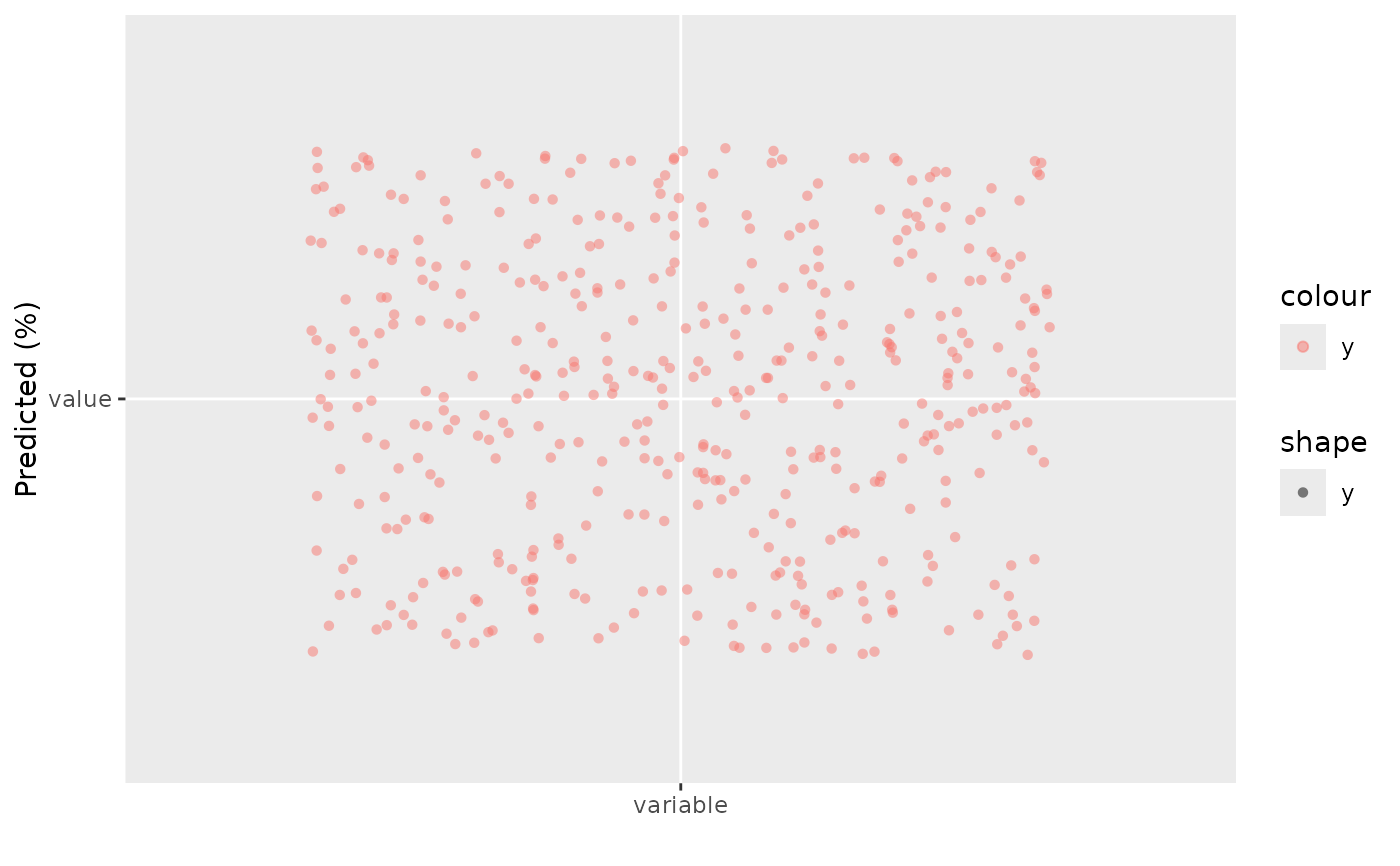
## -------- iris data
set.seed(42)
rfsrc_iris <- randomForestSRC::rfsrc(Species ~ ., data = iris, ntree = 50)
gg_dta <- gg_rfsrc(rfsrc_iris)
plot(gg_dta)
 # \donttest{
## ------------------------------------------------------------
## Additional regression / survival examples are guarded with
## \donttest because the cumulative example time exceeds the
## 10-second CRAN budget. Run locally with `R CMD check --run-donttest`
## (or `devtools::check(run_dont_test = TRUE)`) to exercise them.
## ------------------------------------------------------------
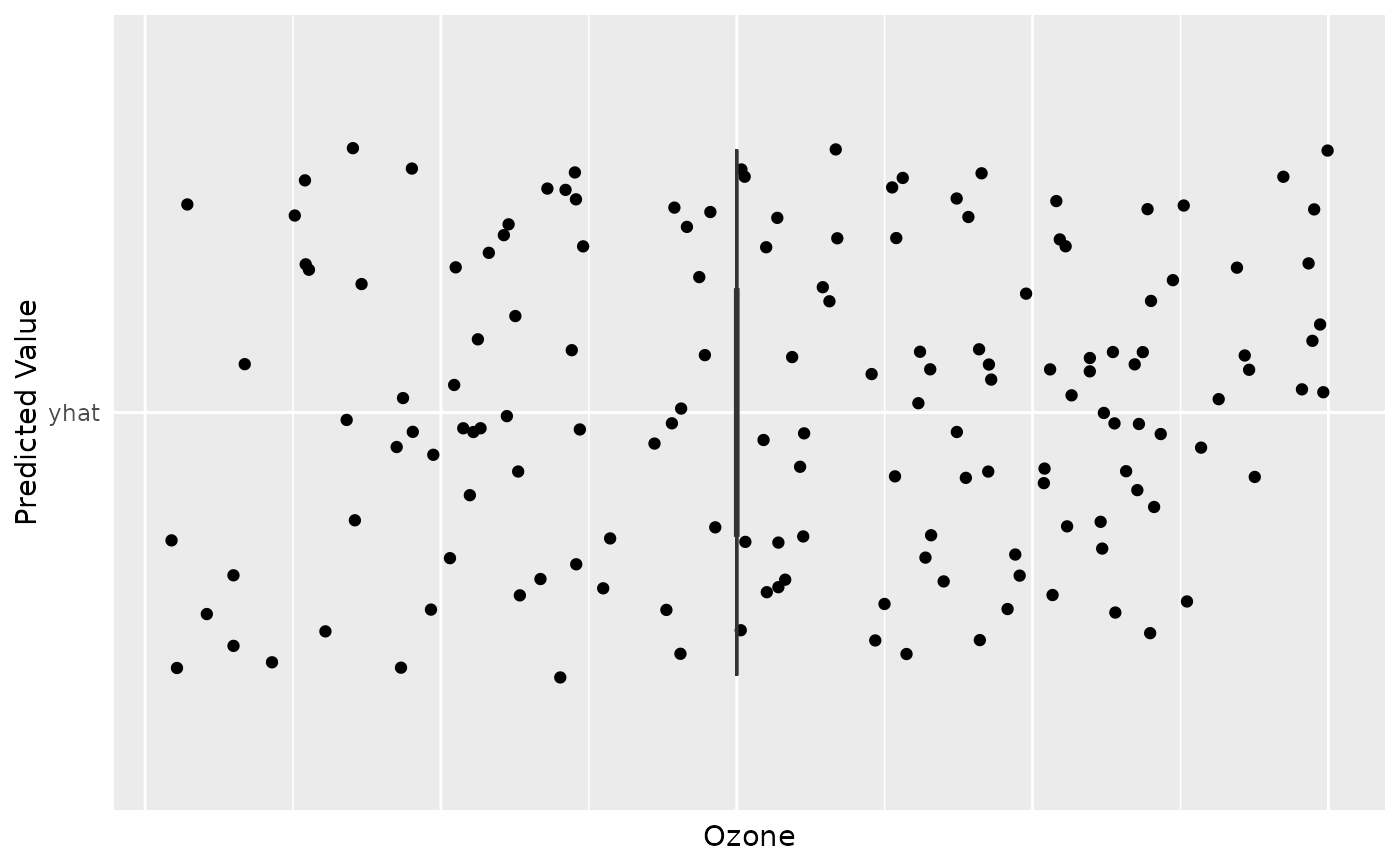
## -------- air quality data (regression)
rfsrc_airq <- randomForestSRC::rfsrc(Ozone ~ ., data = airquality,
na.action = "na.impute", ntree = 50)
plot(gg_rfsrc(rfsrc_airq))
# \donttest{
## ------------------------------------------------------------
## Additional regression / survival examples are guarded with
## \donttest because the cumulative example time exceeds the
## 10-second CRAN budget. Run locally with `R CMD check --run-donttest`
## (or `devtools::check(run_dont_test = TRUE)`) to exercise them.
## ------------------------------------------------------------
## -------- air quality data (regression)
rfsrc_airq <- randomForestSRC::rfsrc(Ozone ~ ., data = airquality,
na.action = "na.impute", ntree = 50)
plot(gg_rfsrc(rfsrc_airq))
 ## -------- Boston data (rfsrc + randomForest)
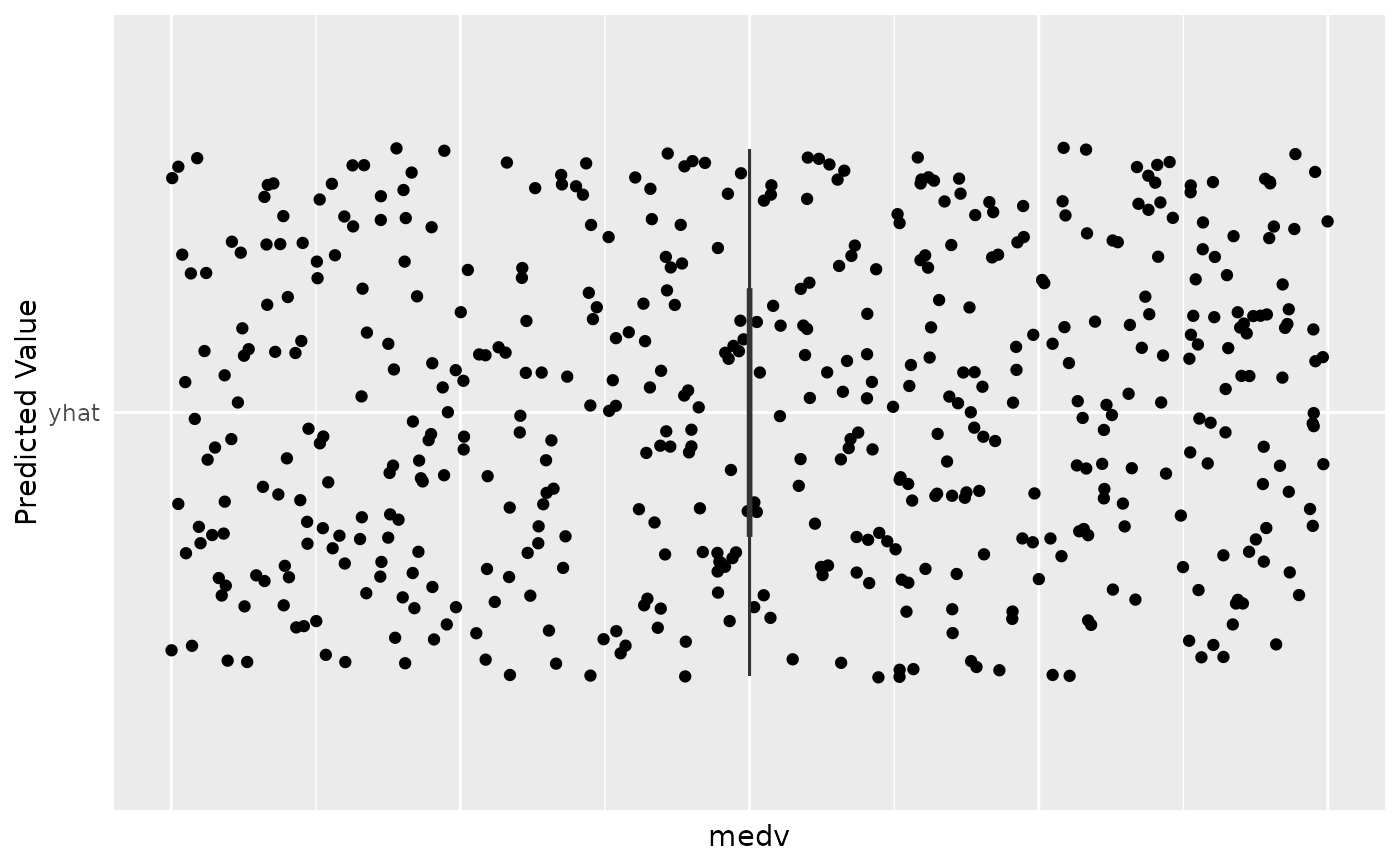
if (requireNamespace("MASS", quietly = TRUE)) {
data(Boston, package = "MASS")
Boston$chas <- as.logical(Boston$chas)
rfsrc_boston <- randomForestSRC::rfsrc(medv ~ ., data = Boston, ntree = 50,
forest = TRUE, importance = TRUE,
tree.err = TRUE, save.memory = TRUE)
plot(gg_rfsrc(rfsrc_boston))
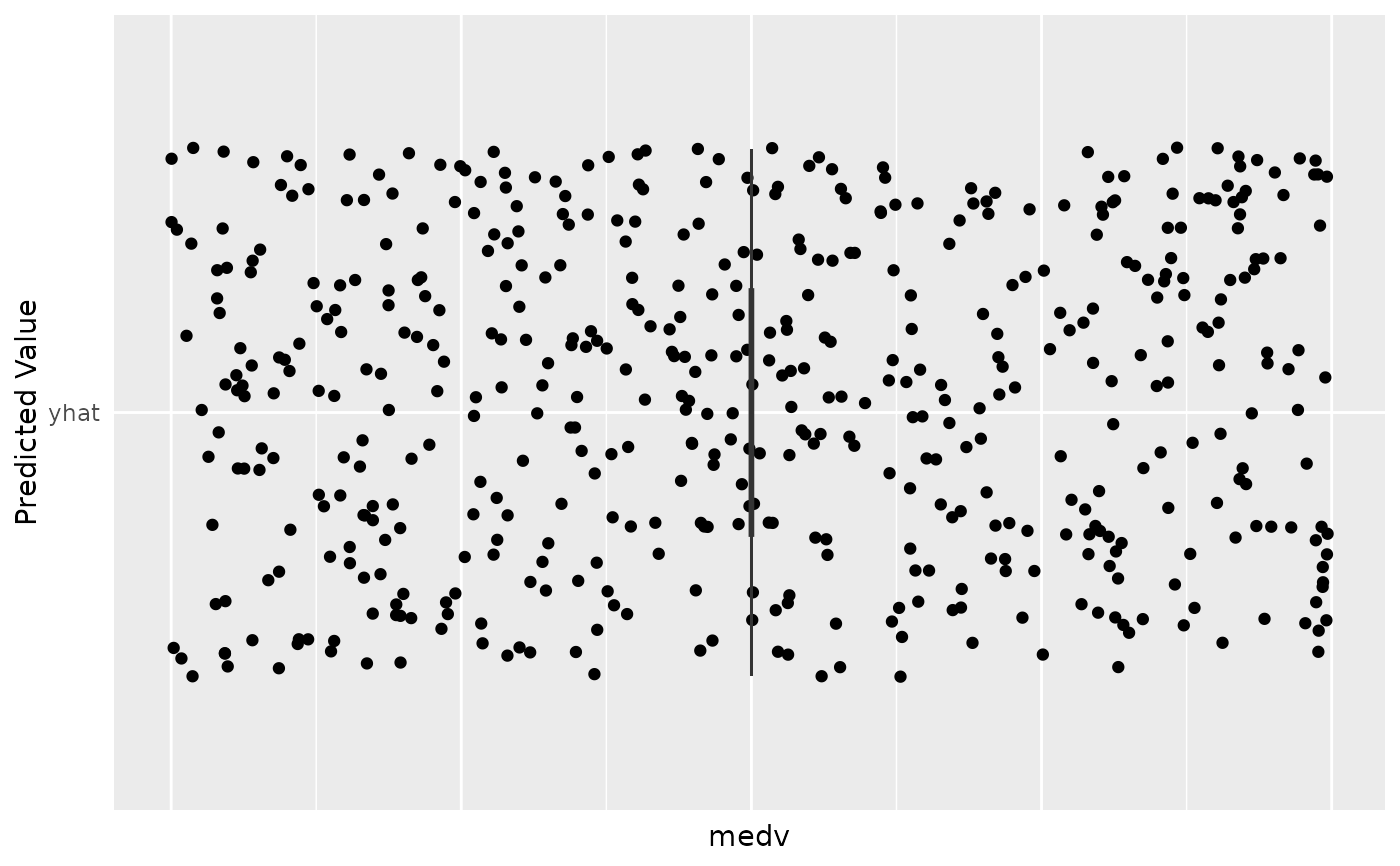
rf_boston <- randomForest::randomForest(medv ~ ., data = Boston,
ntree = 50)
plot(gg_rfsrc(rf_boston))
}
## -------- Boston data (rfsrc + randomForest)
if (requireNamespace("MASS", quietly = TRUE)) {
data(Boston, package = "MASS")
Boston$chas <- as.logical(Boston$chas)
rfsrc_boston <- randomForestSRC::rfsrc(medv ~ ., data = Boston, ntree = 50,
forest = TRUE, importance = TRUE,
tree.err = TRUE, save.memory = TRUE)
plot(gg_rfsrc(rfsrc_boston))
rf_boston <- randomForest::randomForest(medv ~ ., data = Boston,
ntree = 50)
plot(gg_rfsrc(rf_boston))
}
 ## -------- mtcars data
rfsrc_mtcars <- randomForestSRC::rfsrc(mpg ~ ., data = mtcars, ntree = 50)
plot(gg_rfsrc(rfsrc_mtcars))
## -------- mtcars data
rfsrc_mtcars <- randomForestSRC::rfsrc(mpg ~ ., data = mtcars, ntree = 50)
plot(gg_rfsrc(rfsrc_mtcars))
 ## -------- veteran data (survival; with CI and group-by)
data(veteran, package = "randomForestSRC")
rfsrc_veteran <- randomForestSRC::rfsrc(Surv(time, status) ~ ., data = veteran,
ntree = 50)
plot(gg_rfsrc(rfsrc_veteran))
## -------- veteran data (survival; with CI and group-by)
data(veteran, package = "randomForestSRC")
rfsrc_veteran <- randomForestSRC::rfsrc(Surv(time, status) ~ ., data = veteran,
ntree = 50)
plot(gg_rfsrc(rfsrc_veteran))
 plot(gg_rfsrc(rfsrc_veteran, conf.int = .95))
 plot(gg_rfsrc(rfsrc_veteran, by = "trt"))
 # }
# }