Plot a gg_variable object,
Usage
# S3 method for class 'gg_variable'
plot(
  x,
  xvar,
  panel = FALSE,
  oob = TRUE,
  points = TRUE,
  smooth = TRUE,
  labels = NULL,
  ...,
  time_units = NULL
)
Arguments
- x
gg_variableobject created from arfsrcobject- xvar
variable (or list of variables) of interest.
- panel
Should plots be faceted along multiple xvar?
- oob
oob estimates (boolean)
- points
plot the raw data points (boolean)
- smooth
include a smooth curve (boolean)
- labels
Optional variable labels. One of: a named character vector (
c(wt = "Weight")); a labelled data frame, whoseattr(col, "label")values are read; or a two-columnkey/labeldata frame. Variables with no label keep their raw name. Applied to the facet strips in the panel plot and to the x axis title in the individual plot. Defaults toNULL(raw names).- ...
arguments passed to the
ggplot2functions.- time_units
Optional name of the time unit the forest was fit in, used only in the survival y axis title. The horizon is chosen at
gg_variable(rf, time = 1191);plot(gg_dta)then titles the axis"Survival at 1191", andtime_units = "days"makes that"Survival at 1191 days". Nothing on anrfsrcobject records the unit, so the package cannot infer it. Defaults toNULL(no unit printed). Not printed when multiple times are faceted.
Value
A single ggplot object when length(xvar) == 1 or
panel = TRUE; otherwise a patchwork composite that stacks
one panel per variable in xvar. Either way the result is one
plottable object, never a bare list, so it composes with
patchwork and dispatches through ggplot2::autoplot().
For the patchwork case, to inspect one panel with
ggplot2::layer_data() pull that panel out first
(e.g. ggplot2::layer_data(p[[1]])).
References
Breiman L. (2001). Random forests, Machine Learning, 45:5-32.
Ishwaran H. and Kogalur U.B. (2007). Random survival forests for R, Rnews, 7(2):25-31.
Ishwaran H, Kogalur U (2026). Fast Unified Random Forests for Survival, Regression, and Classification (RF-SRC). R package version 3.6.2. https://cran.r-project.org/package=randomForestSRC
Examples
## ------------------------------------------------------------
## classification
## ------------------------------------------------------------
## -------- iris data
set.seed(42)
rfsrc_iris <- randomForestSRC::rfsrc(Species ~ ., data = iris, ntree = 50)
gg_dta <- gg_variable(rfsrc_iris)
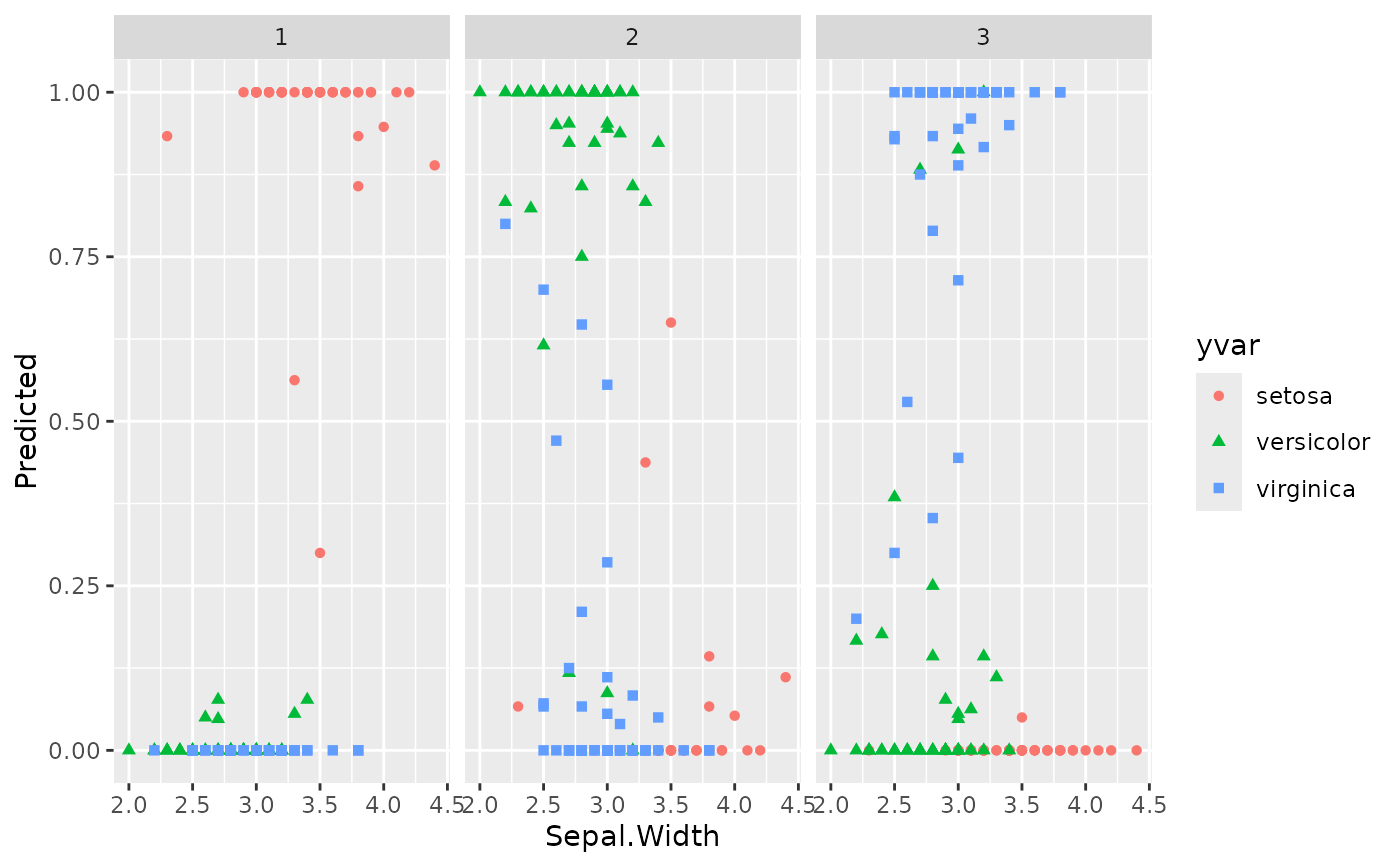
plot(gg_dta, xvar = "Sepal.Width")
#> `geom_smooth()` using method = 'loess' and formula = 'y ~ x'
 plot(gg_dta, xvar = "Sepal.Length")
#> `geom_smooth()` using method = 'loess' and formula = 'y ~ x'
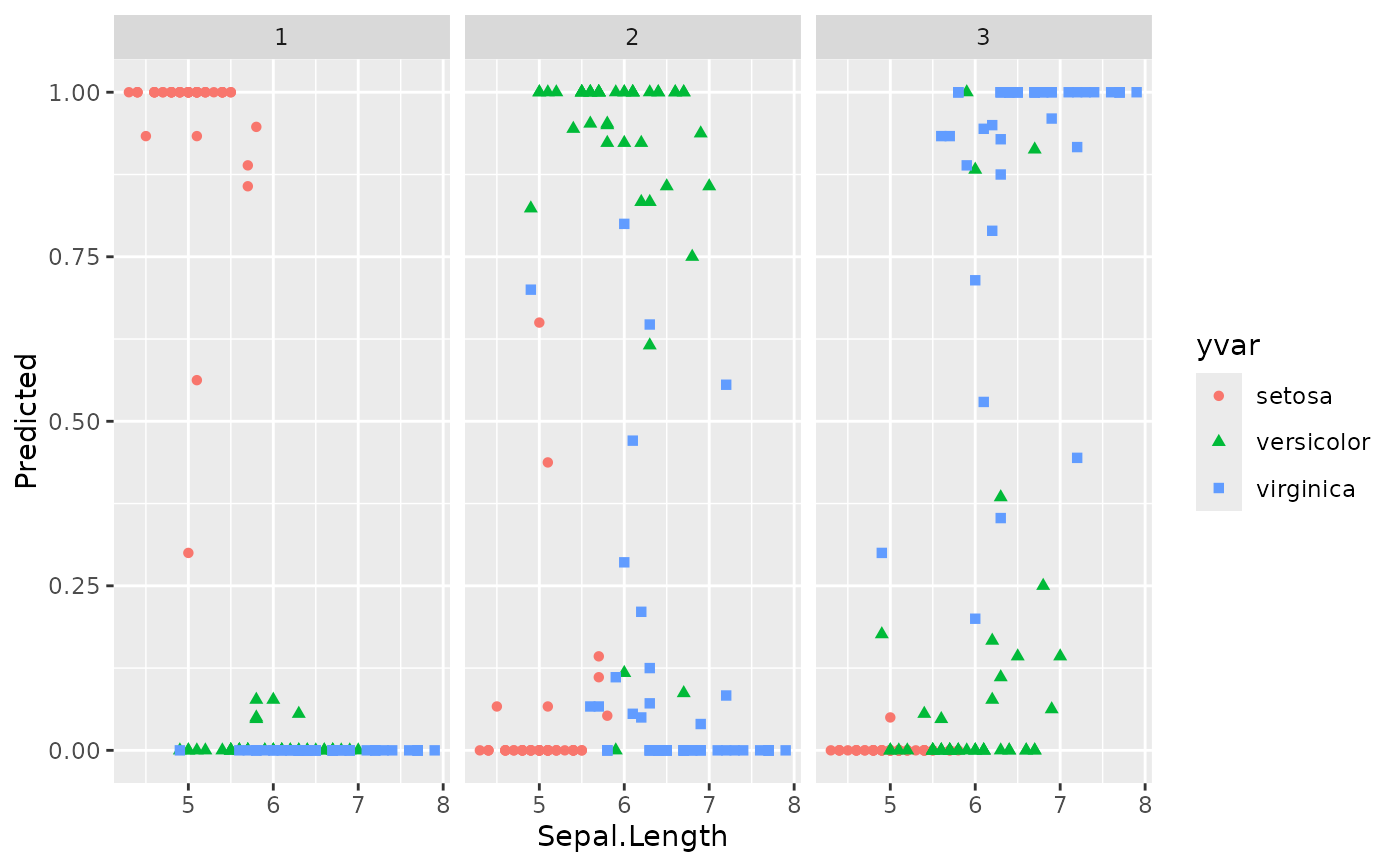
plot(gg_dta, xvar = "Sepal.Length")
#> `geom_smooth()` using method = 'loess' and formula = 'y ~ x'
 ## Panel plot across all predictors
plot(gg_dta,
xvar = rfsrc_iris$xvar.names,
panel = TRUE, se = FALSE
)
#> Warning: Ignoring unknown parameters: `se`
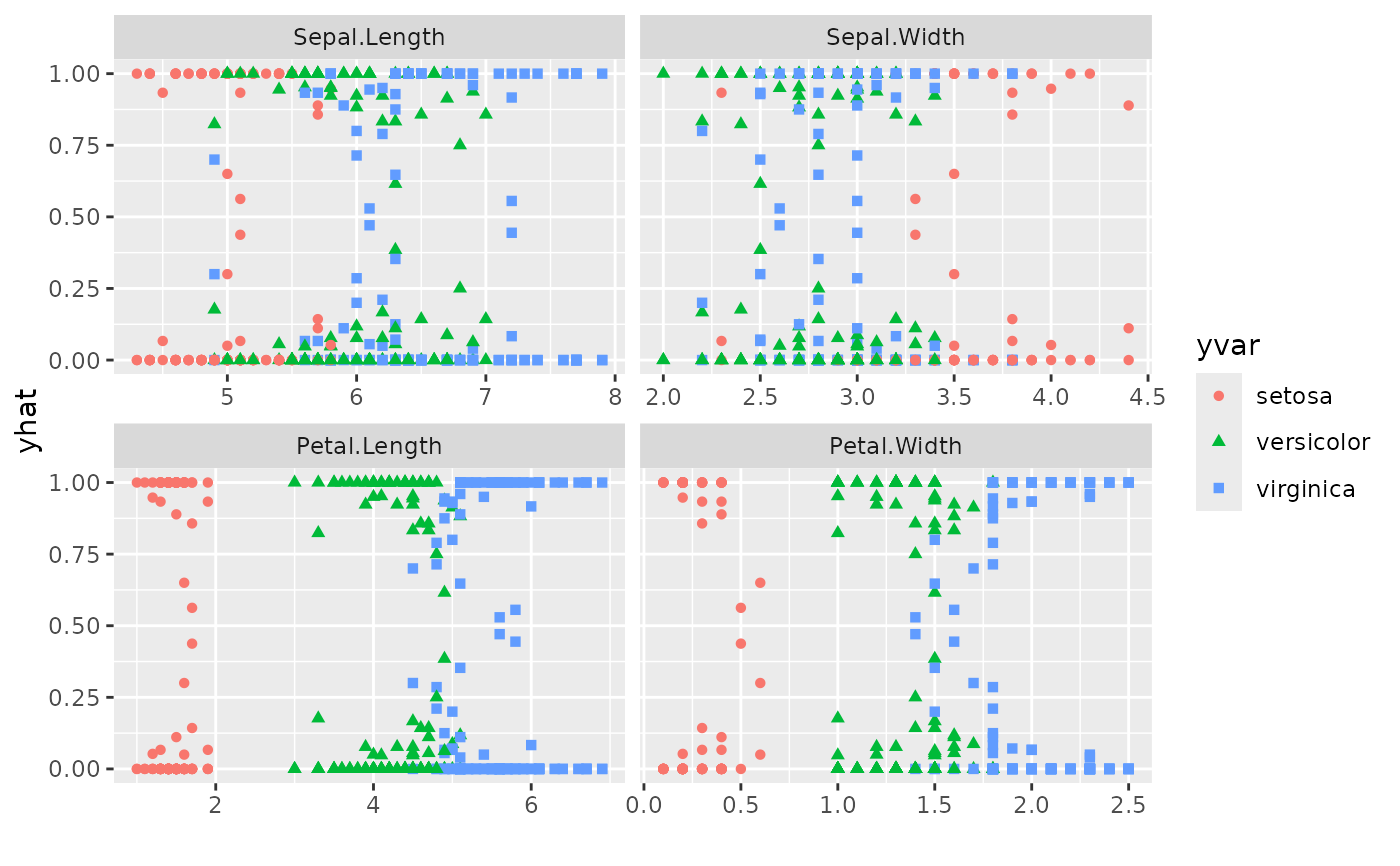
## Panel plot across all predictors
plot(gg_dta,
xvar = rfsrc_iris$xvar.names,
panel = TRUE, se = FALSE
)
#> Warning: Ignoring unknown parameters: `se`
 ## ------------------------------------------------------------
## regression
## ------------------------------------------------------------
## -------- air quality data
# na.action = "na.impute" handles missing Ozone / Solar.R values
set.seed(42)
rfsrc_airq <- randomForestSRC::rfsrc(Ozone ~ ., data = airquality,
na.action = "na.impute", ntree = 50)
gg_dta <- gg_variable(rfsrc_airq)
# Treat Month as an ordinal factor for better visualization
gg_dta[, "Month"] <- factor(gg_dta[, "Month"])
plot(gg_dta, xvar = "Wind")
#> `geom_smooth()` using method = 'loess' and formula = 'y ~ x'
## ------------------------------------------------------------
## regression
## ------------------------------------------------------------
## -------- air quality data
# na.action = "na.impute" handles missing Ozone / Solar.R values
set.seed(42)
rfsrc_airq <- randomForestSRC::rfsrc(Ozone ~ ., data = airquality,
na.action = "na.impute", ntree = 50)
gg_dta <- gg_variable(rfsrc_airq)
# Treat Month as an ordinal factor for better visualization
gg_dta[, "Month"] <- factor(gg_dta[, "Month"])
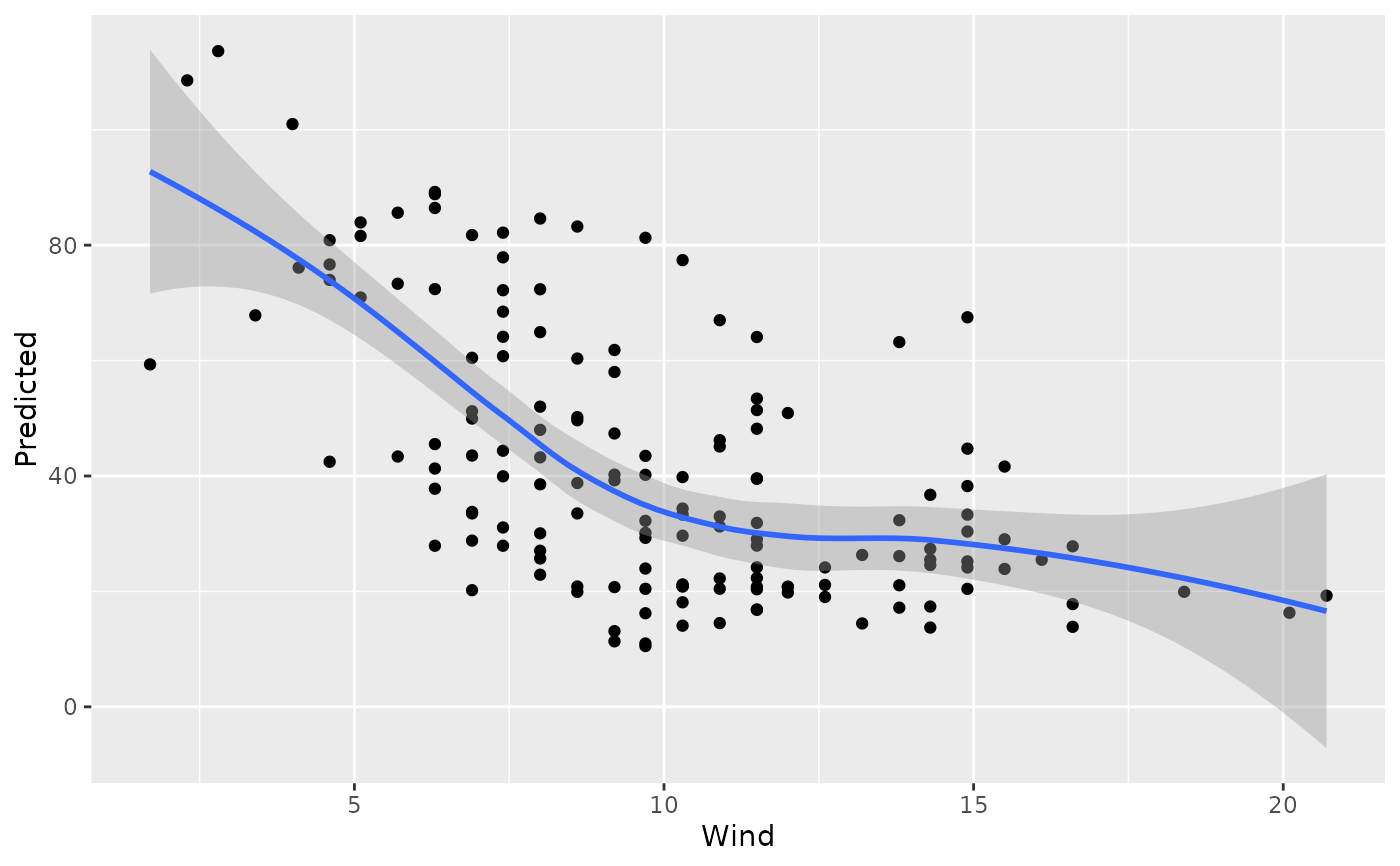
plot(gg_dta, xvar = "Wind")
#> `geom_smooth()` using method = 'loess' and formula = 'y ~ x'
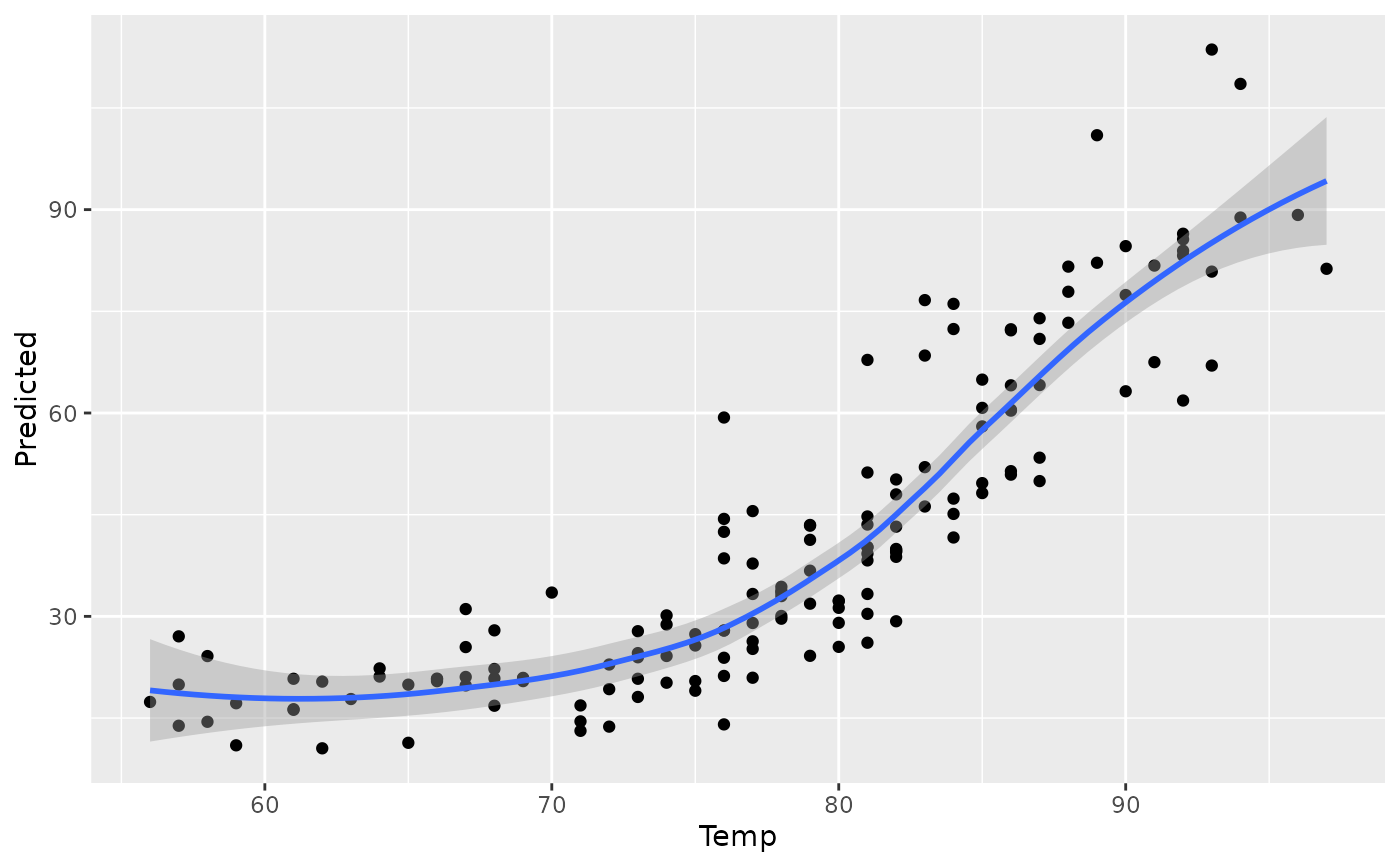
 plot(gg_dta, xvar = "Temp")
#> `geom_smooth()` using method = 'loess' and formula = 'y ~ x'
plot(gg_dta, xvar = "Temp")
#> `geom_smooth()` using method = 'loess' and formula = 'y ~ x'
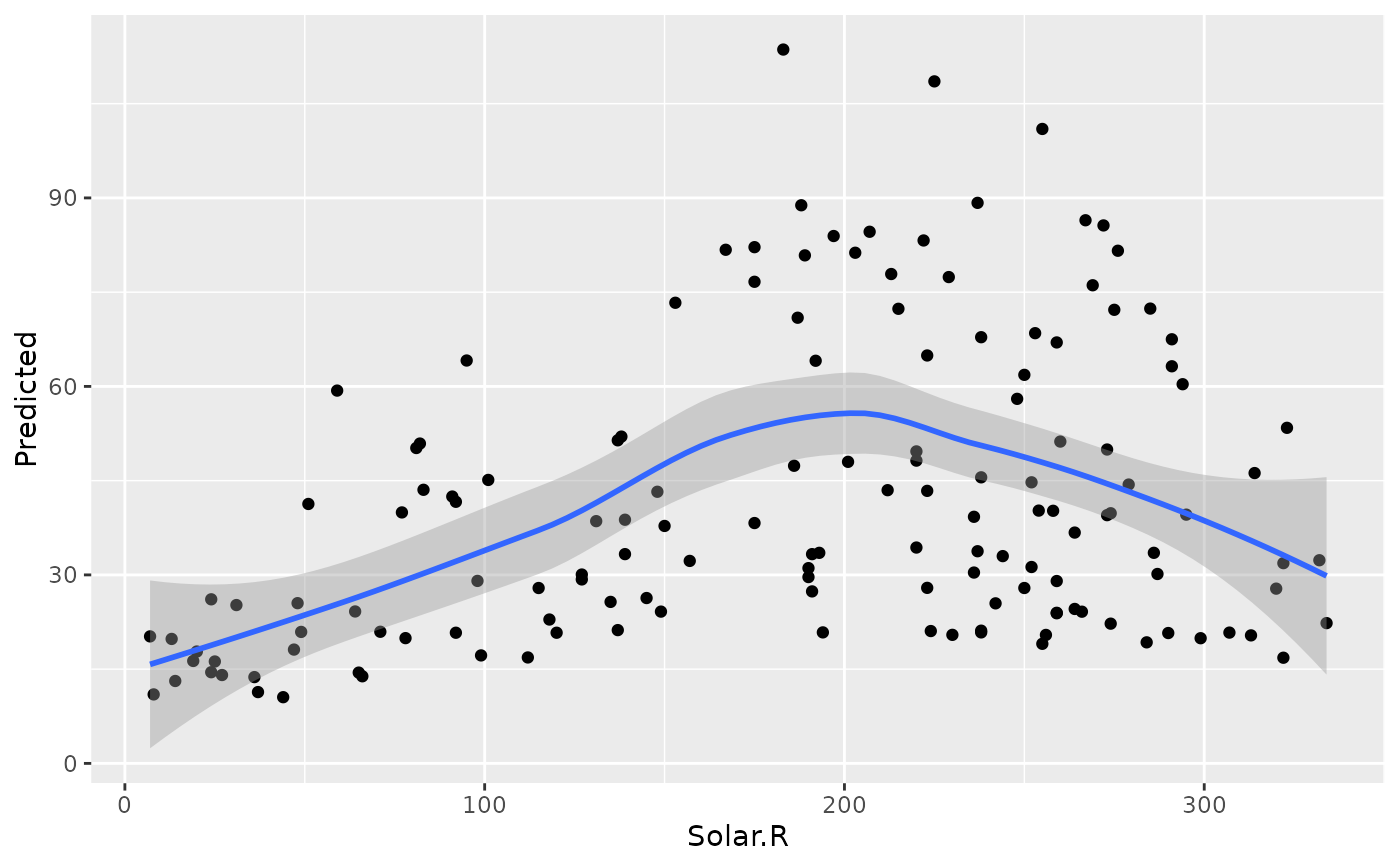
 plot(gg_dta, xvar = "Solar.R")
#> `geom_smooth()` using method = 'loess' and formula = 'y ~ x'
#> Warning: Removed 7 rows containing non-finite outside the scale range (`stat_smooth()`).
#> Warning: Removed 7 rows containing missing values or values outside the scale range
#> (`geom_point()`).
plot(gg_dta, xvar = "Solar.R")
#> `geom_smooth()` using method = 'loess' and formula = 'y ~ x'
#> Warning: Removed 7 rows containing non-finite outside the scale range (`stat_smooth()`).
#> Warning: Removed 7 rows containing missing values or values outside the scale range
#> (`geom_point()`).
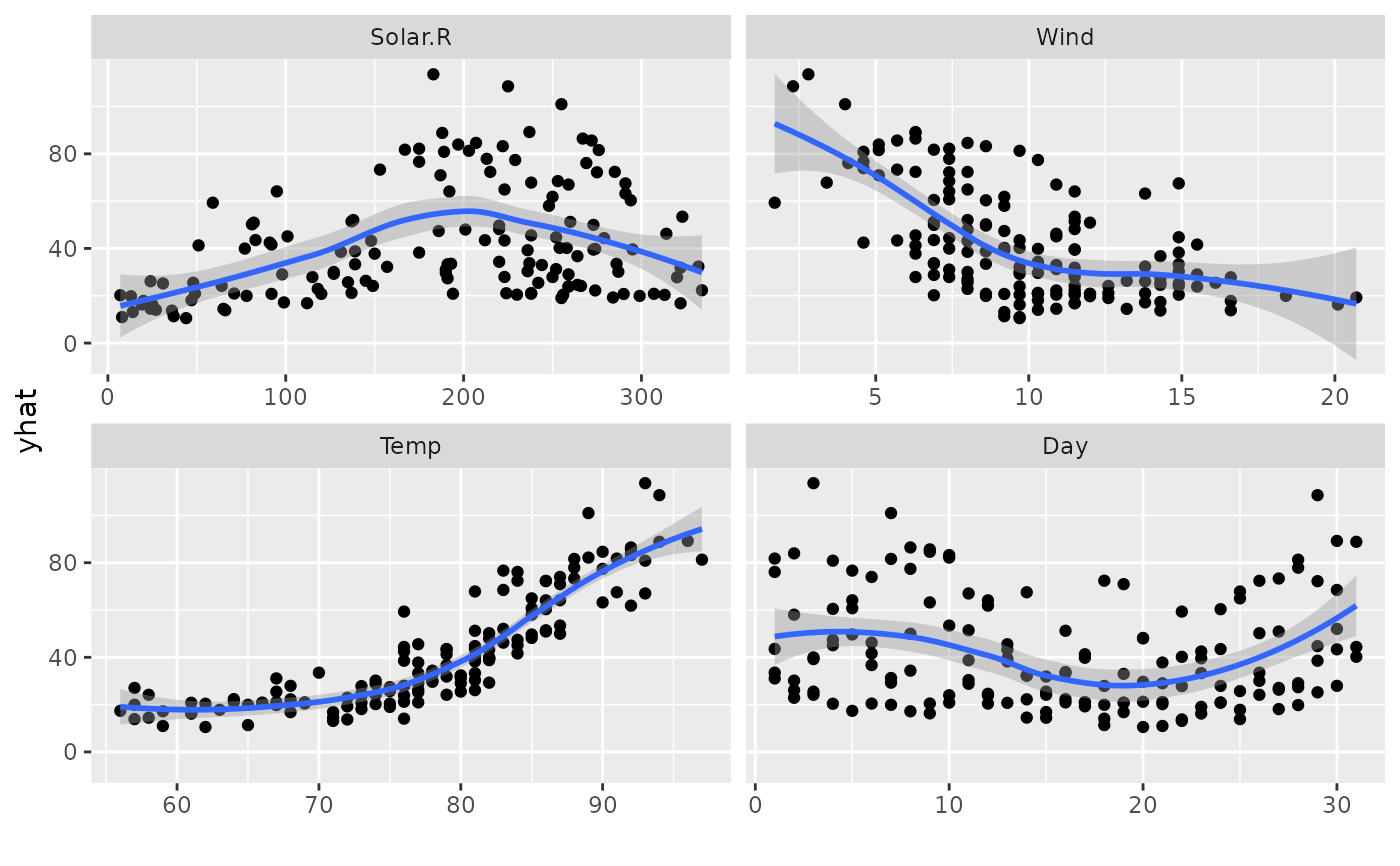
 # Factor variable uses notched boxplots
plot(gg_dta, xvar = "Month", notch = TRUE)
#> Warning: Ignoring unknown parameters: `notch`
#> Notch went outside hinges
#> ℹ Do you want `notch = FALSE`?
# Factor variable uses notched boxplots
plot(gg_dta, xvar = "Month", notch = TRUE)
#> Warning: Ignoring unknown parameters: `notch`
#> Notch went outside hinges
#> ℹ Do you want `notch = FALSE`?
 # \donttest{
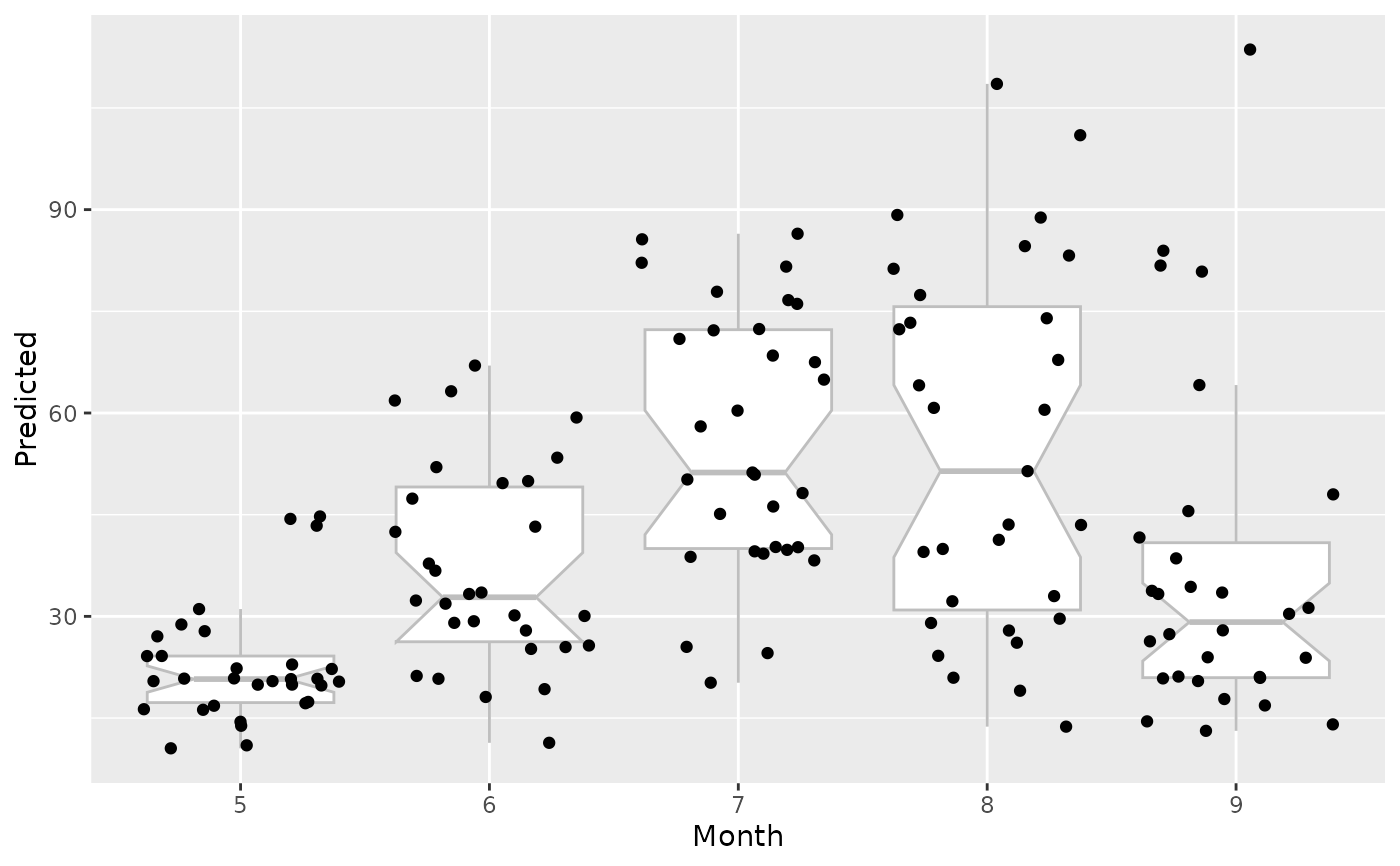
# Panel plot across continuous predictors (loess smooths; slower)
plot(gg_dta, xvar = c("Solar.R", "Wind", "Temp", "Day"), panel = TRUE)
#> `geom_smooth()` using method = 'loess' and formula = 'y ~ x'
#> Warning: Removed 7 rows containing non-finite outside the scale range (`stat_smooth()`).
#> Warning: Removed 7 rows containing missing values or values outside the scale range
#> (`geom_point()`).
#> Warning: Removed 7 rows containing missing values or values outside the scale range
#> (`geom_point()`).
# \donttest{
# Panel plot across continuous predictors (loess smooths; slower)
plot(gg_dta, xvar = c("Solar.R", "Wind", "Temp", "Day"), panel = TRUE)
#> `geom_smooth()` using method = 'loess' and formula = 'y ~ x'
#> Warning: Removed 7 rows containing non-finite outside the scale range (`stat_smooth()`).
#> Warning: Removed 7 rows containing missing values or values outside the scale range
#> (`geom_point()`).
#> Warning: Removed 7 rows containing missing values or values outside the scale range
#> (`geom_point()`).
 # }
## ------------------------------------------------------------
## survival examples
## ------------------------------------------------------------
## -------- veteran data
# \donttest{
data(veteran, package = "randomForestSRC")
set.seed(42)
rfsrc_veteran <- randomForestSRC::rfsrc(Surv(time, status) ~ ., veteran,
nsplit = 10,
ntree = 50
)
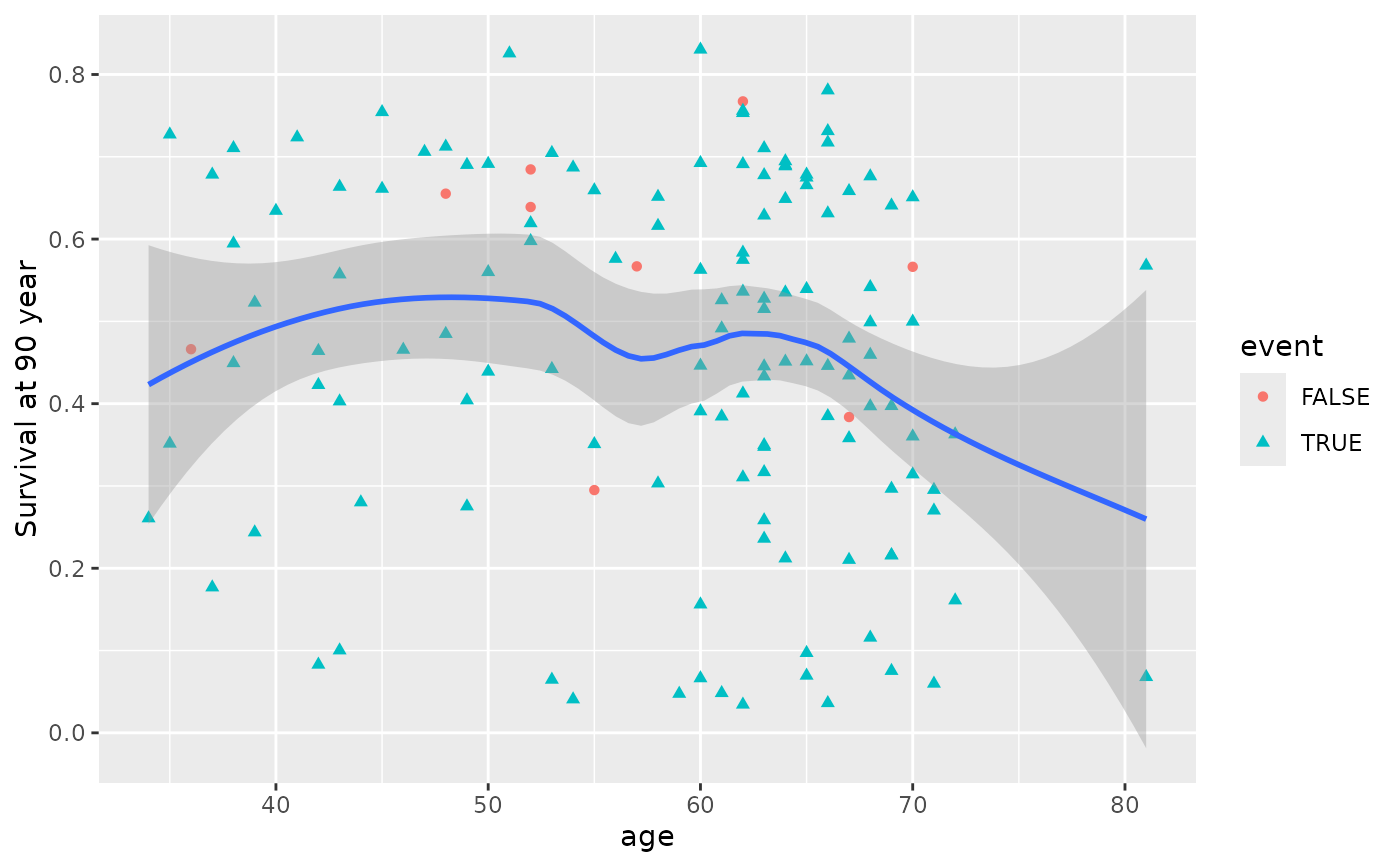
# Marginal survival at 90 days
gg_dta <- gg_variable(rfsrc_veteran, time = 90)
# Single-variable dependence plots
plot(gg_dta, xvar = "age")
#> `geom_smooth()` using method = 'loess' and formula = 'y ~ x'
# }
## ------------------------------------------------------------
## survival examples
## ------------------------------------------------------------
## -------- veteran data
# \donttest{
data(veteran, package = "randomForestSRC")
set.seed(42)
rfsrc_veteran <- randomForestSRC::rfsrc(Surv(time, status) ~ ., veteran,
nsplit = 10,
ntree = 50
)
# Marginal survival at 90 days
gg_dta <- gg_variable(rfsrc_veteran, time = 90)
# Single-variable dependence plots
plot(gg_dta, xvar = "age")
#> `geom_smooth()` using method = 'loess' and formula = 'y ~ x'
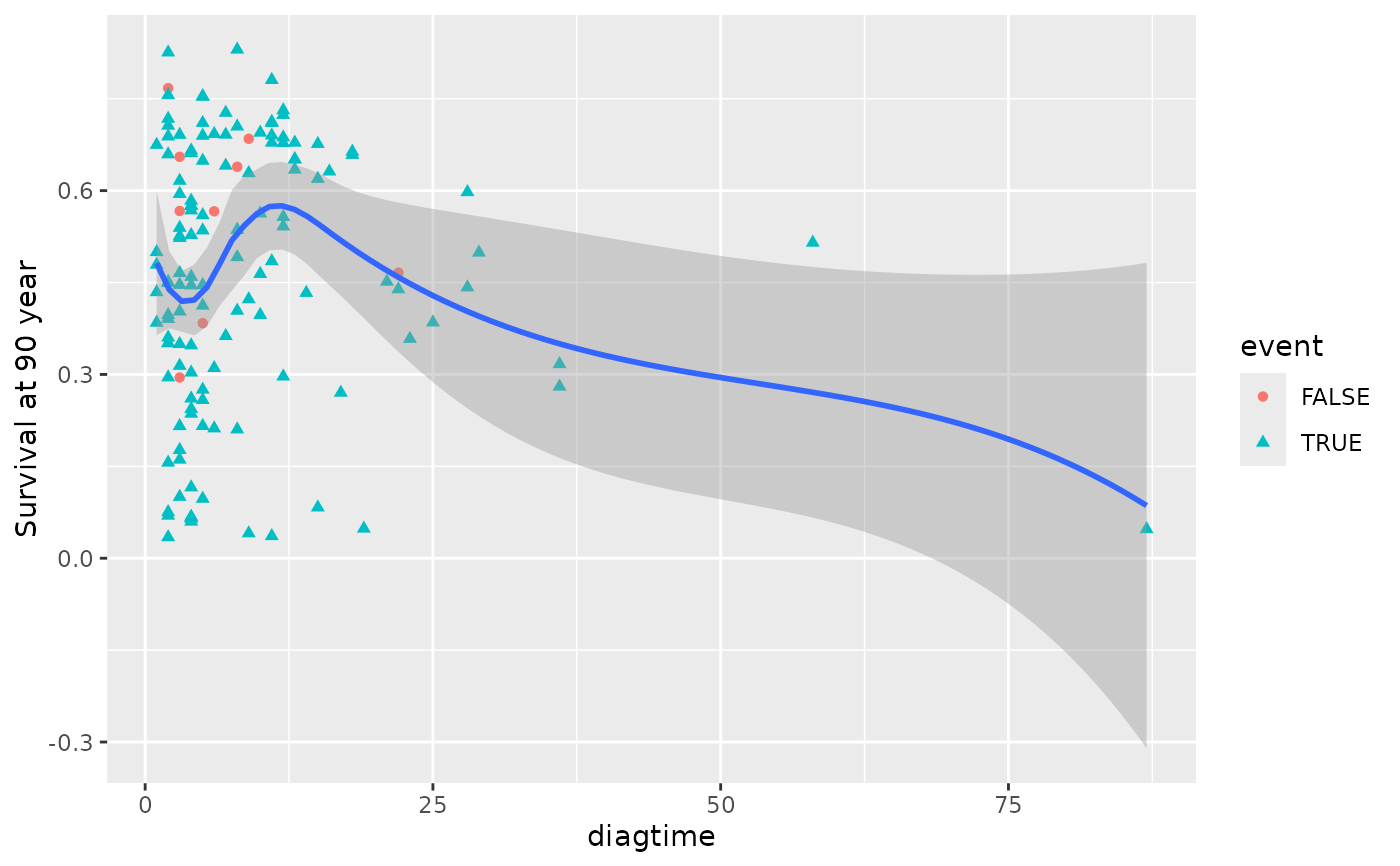
 plot(gg_dta, xvar = "diagtime")
#> `geom_smooth()` using method = 'loess' and formula = 'y ~ x'
plot(gg_dta, xvar = "diagtime")
#> `geom_smooth()` using method = 'loess' and formula = 'y ~ x'
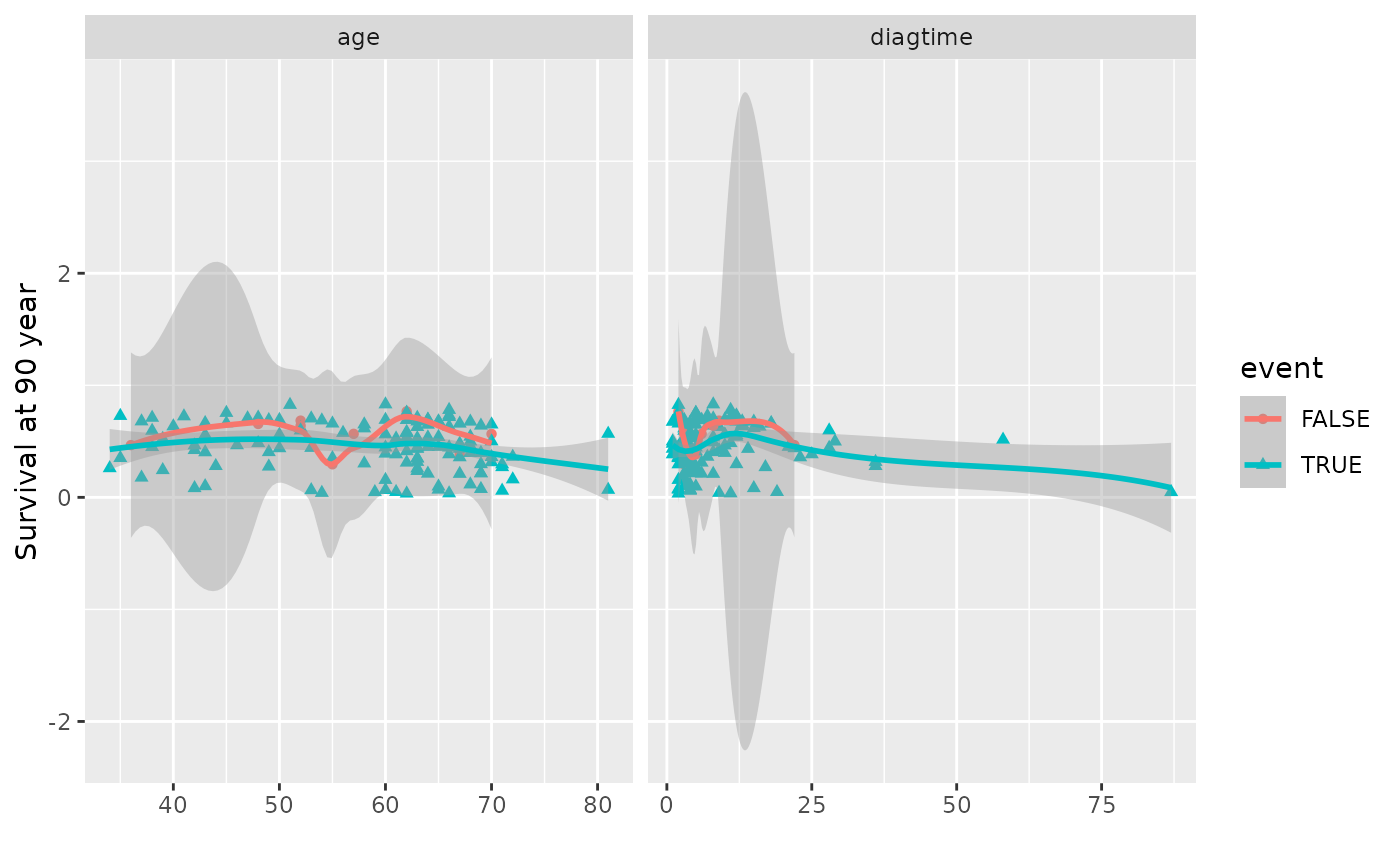
 # Panel coplot for two predictors at a single time
plot(gg_dta, xvar = c("age", "diagtime"), panel = TRUE)
#> `geom_smooth()` using method = 'loess' and formula = 'y ~ x'
# Panel coplot for two predictors at a single time
plot(gg_dta, xvar = c("age", "diagtime"), panel = TRUE)
#> `geom_smooth()` using method = 'loess' and formula = 'y ~ x'
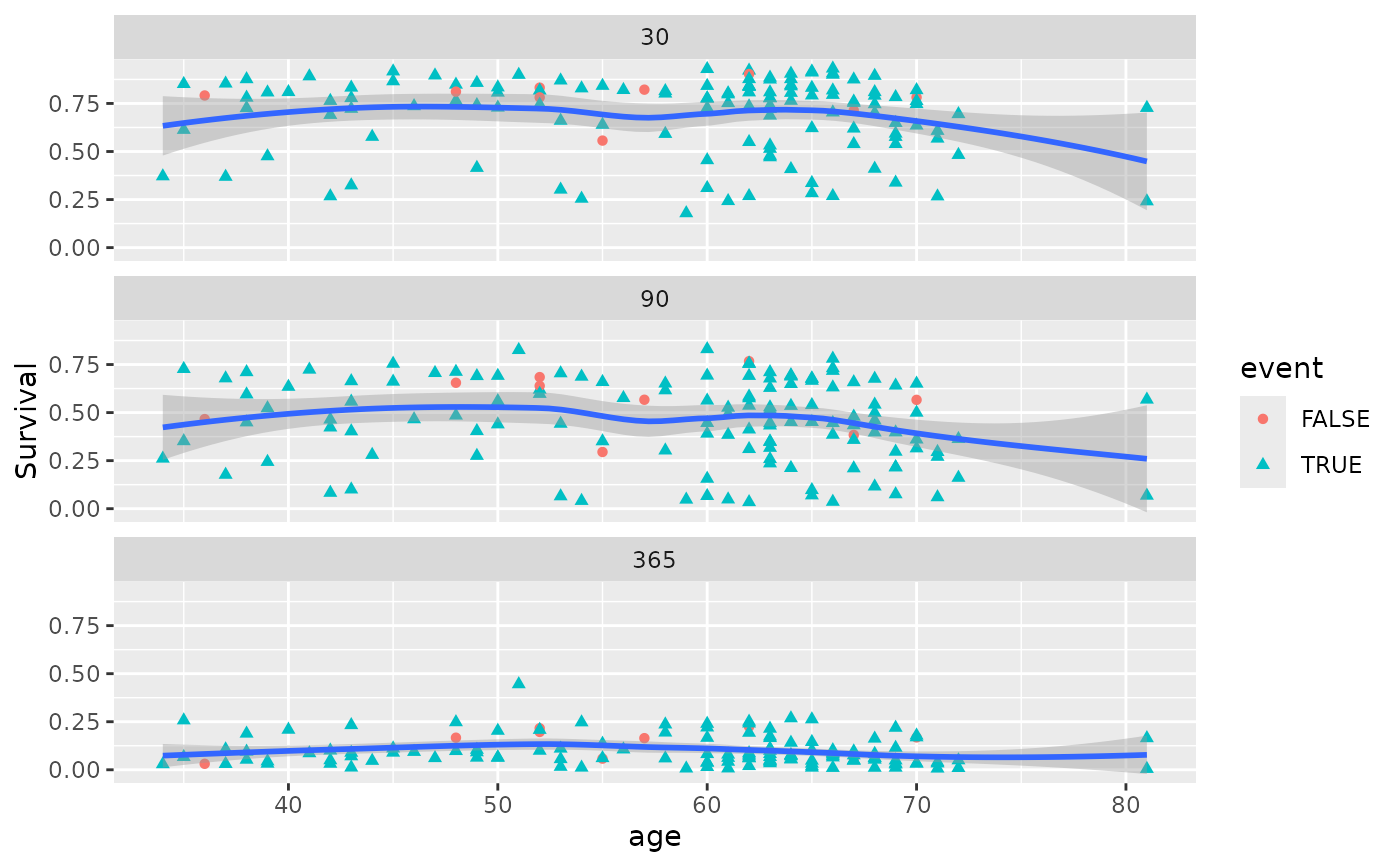
 # Compare survival at 30, 90, and 365 days simultaneously
gg_dta <- gg_variable(rfsrc_veteran, time = c(30, 90, 365))
# Single-variable plot (one facet per time point)
plot(gg_dta, xvar = "age")
#> `geom_smooth()` using method = 'loess' and formula = 'y ~ x'
# Compare survival at 30, 90, and 365 days simultaneously
gg_dta <- gg_variable(rfsrc_veteran, time = c(30, 90, 365))
# Single-variable plot (one facet per time point)
plot(gg_dta, xvar = "age")
#> `geom_smooth()` using method = 'loess' and formula = 'y ~ x'
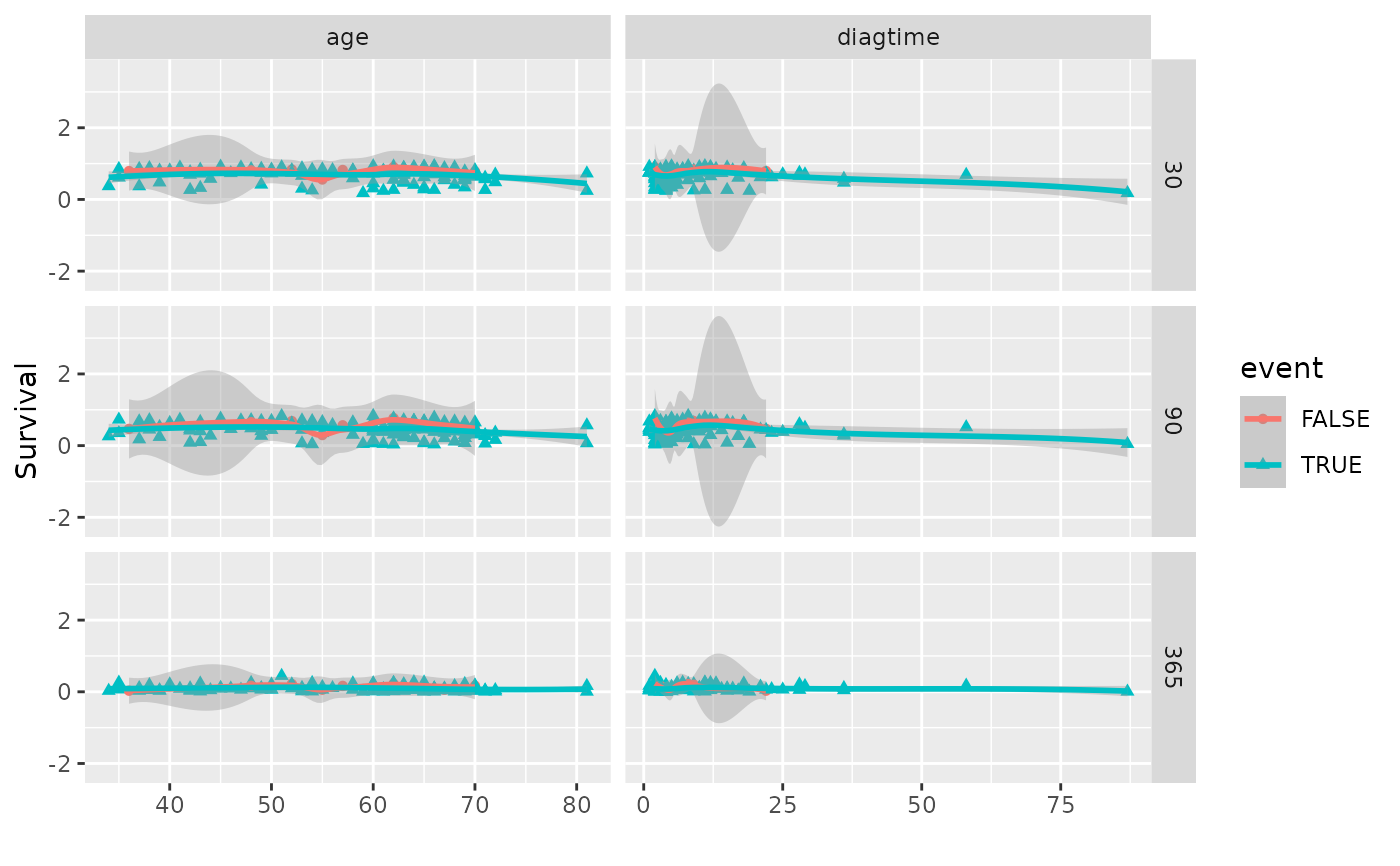
 # Panel coplot across two predictors and three time points
plot(gg_dta, xvar = c("age", "diagtime"), panel = TRUE)
#> `geom_smooth()` using method = 'loess' and formula = 'y ~ x'
# Panel coplot across two predictors and three time points
plot(gg_dta, xvar = c("age", "diagtime"), panel = TRUE)
#> `geom_smooth()` using method = 'loess' and formula = 'y ~ x'
 # }
# }