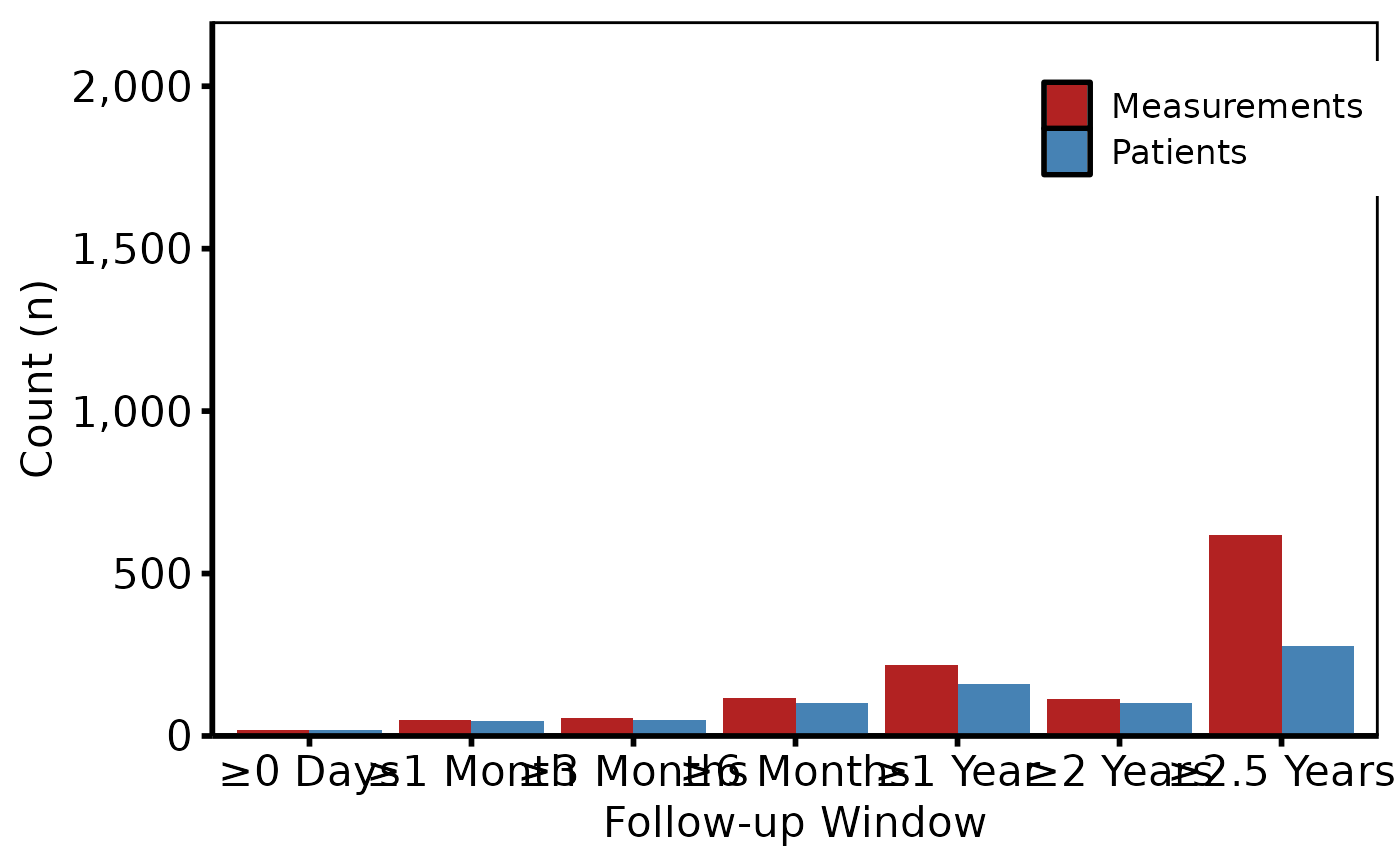
Prepare longitudinal participation counts data for plotting
Source:R/longitudinal-counts-plot.R
hv_longitudinal.RdValidates a pre-aggregated long-format counts data frame and returns an
hv_longitudinal object. Call plot.hv_longitudinal
on the result with type = "plot" for the grouped bar chart or
type = "table" for the numeric text-table panel. Compose both
panels with patchwork.
Arguments
- data
Long-format data frame; one row per series per time point. See
sample_longitudinal_counts_data.- x_col
Name of the discrete time-label column. Default
"time_label".- count_col
Name of the numeric count column. Default
"count".- group_col
Name of the series grouping column. Default
"series".
Value
An object of class c("hv_longitudinal", "hv_data"):
$dataThe validated input data frame.
$metaNamed list:
x_col,count_col,group_col,n_timepoints,n_groups,n_obs.$tablesEmpty list.
See also
Worked recipe with rendered output: https://ehrlinger.github.io/hvtiGraphics/bar.html.
Examples
dta <- sample_longitudinal_counts_data(n_patients = 300, seed = 42L)

# 1. Build data object
lc <- hv_longitudinal(dta)
lc  # prints group/time-point counts
#> <hv_longitudinal>
#>   Time points : 7
#>   Groups      : 2  (14 rows)
#>   x / count / group : time_label / count / series

# 2. Bare plot -- undecorated ggplot returned by plot.hv_longitudinal
library(ggplot2)
p <- plot(lc, type = "plot")

# 3. Decorate: fill palette, y-axis scale, labels, theme
p +
  scale_fill_manual(
    values = c(Patients = "steelblue", Measurements = "firebrick"),
    name   = NULL
  ) +
  scale_y_continuous(labels = scales::comma,
                     breaks = seq(0, 2000, 500),
                     expand = c(0, 0)) +
  coord_cartesian(ylim = c(0, 2200)) +
  labs(x = "Follow-up Window", y = "Count (n)") +
  theme_hv_poster() +
  theme(legend.position = c(0.85, 0.85))