Extracts case-specific ensemble hazard and cumulative-hazard estimates from
a fitted randomForestRHF::rhf() object into a tidy long data frame, one
row per (case, time) pair on the forest's time.interest grid.
Usage
gg_rhf(object, ...)

# S3 method for class 'rhf'
gg_rhf(object, source = c("oob", "inbag"), ...)Value
A data.frame of class c("gg_rhf", "data.frame") with columns
id, time, hazard, chf, source, an integer ntime attribute
(number of grid points), and a provenance attribute.
The frame always has ntime rows per case. Both hazard and chf may be
NA, and they are masked on different rules. From randomForestRHF
2.0.0 the pointwise hazard is defined only where a grid point falls inside
one of the case's supplied (start, stop] intervals, and is NA in gaps
and after the final stop time. From 2.0.3 the cumulative hazard is NA
after each case's final stop, but stays flat through an internal gap
rather than going missing there. So on a fit whose cases each have a
single interval the two masks look the same, and with time-dependent
covariates they do not. Earlier versions carried chf across the whole
grid. The values are passed through unchanged; use na.rm = TRUE when
summarising either column, or see plot.gg_rhf(), which drops the masked
cells before drawing.
References
Ishwaran H, Hsich EM, Kogalur UB, Lee DKK (2026). Random Hazard Forests. arXiv:2608.21597. doi:10.48550/arXiv.2608.21597 .
Ishwaran H, Kogalur UB (2026). randomForestRHF: Random Hazard Forests. R package version 2.0.3. https://CRAN.R-project.org/package=randomForestRHF.
Examples
# \donttest{
if (requireNamespace("randomForestRHF", quietly = TRUE)) {
data(pbc, package = "randomForestSRC")
d <- randomForestRHF::convert.counting(
survival::Surv(days, status) ~ ., na.omit(pbc))
o <- randomForestRHF::rhf("Surv(id, start, stop, event) ~ .", d, ntree = 30)
gg <- gg_rhf(o)
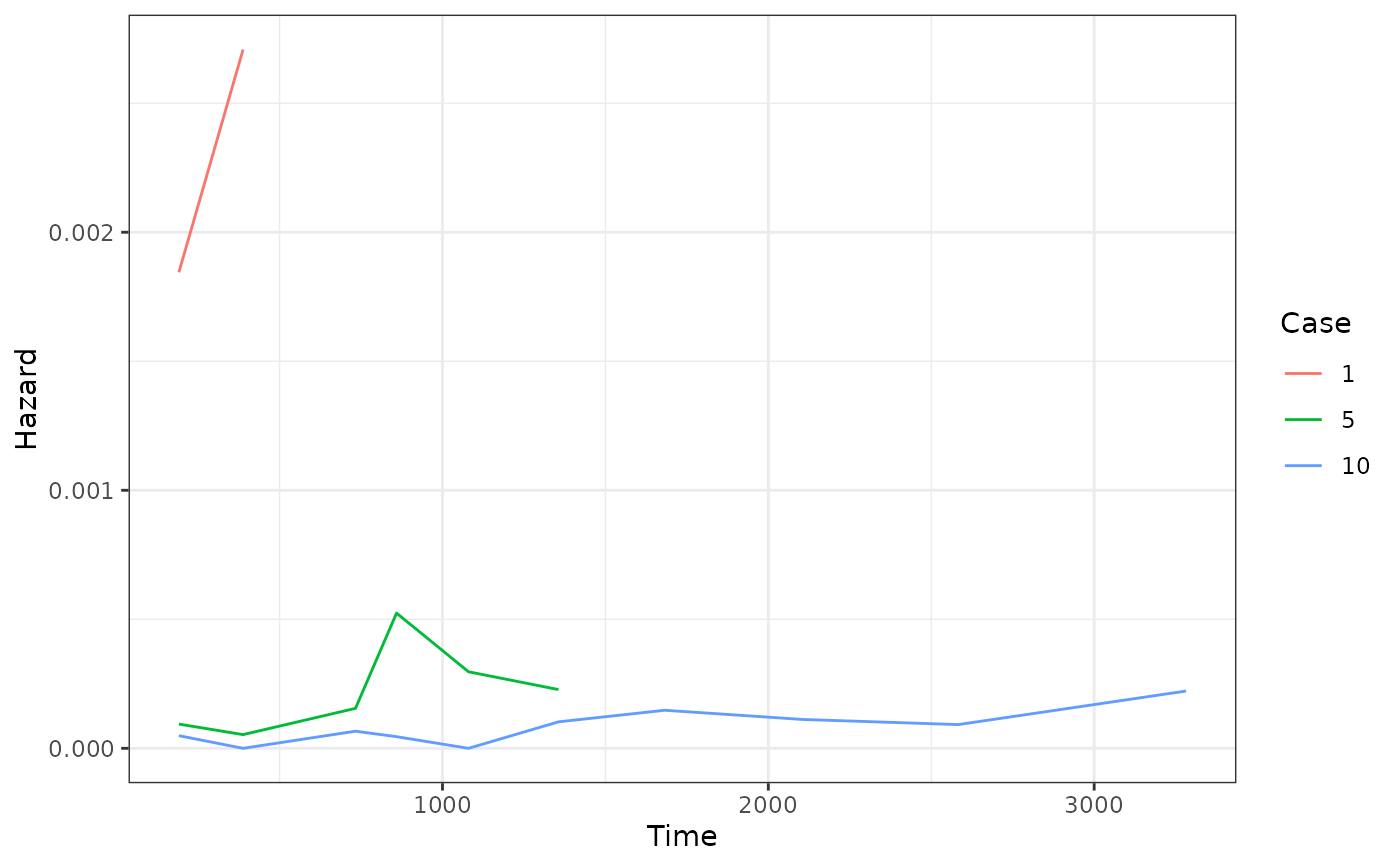
plot(gg, idx = c(1, 5, 10))
}
 # }
# }